I filmed a music video at my ex-situationship's music video themed birthday party (a manifesto)
There is a time in every woman’s life where she must confront her sexualisation with ironic detachment. Where the condition of sitting on the line between being desired and being disgusting forms, there is the potential for public spectacle. The process of idealisation can be the basis for the disavowal of current social conditions. At the level of the personal, I have spent the last year grappling with a series of intimate personal relationships which have left me asking the question if I was ever really there at all.
These conditions reinforce the terrain of popular media, specifically in the life of the popstar. Their intimate moments become points of referentiality or information, rather than conditions of being personal. The popstar is always under investigation, the site of investigation primarily being their body. My point is: when you can’t take your life seriously anymore because the conditions seem to absolve you of being a self or a subject, sometimes you need to move to a different form of individuation.
So when your ex-situationship invites you to his music video themed birthday party, there is only one option. You go as yourself, filming your music video for “your” song which is not even really yours. In this music video, you refer to the background of your life, the place where you spent considerable time for the last year, other songs you have made that cannot be accessed, and events that remain at the level of the cryptic or symbolic. In doing so, you make the suggestion that when these life conditions feel outside of your control, you can subvert these conditions first through affirmation, then through disavowal. This is commonly known as the process of humour.
For the past two years myself and my best friend/creative director/the gay man that controls me have been re-recording popular music as a form of autotheory about my life. The music has been finalised, but not released. I would say there are two reasons for this. The first is that all good performance art, even when it plays with reproducibility, also plays with the singularity of duration. So, my music, whilst it is a reproduction, only happens in iterations of “one”. Secondly, having the music being publicly inaccessible beyond being referenced points to the system of reference that constructs popular music itself. It does this in an act of disappearing the object that is referenced. Thus, we are constructing singular objects which are infinitely referential.
As I see it, although it has been described as more situationist than Dadaist, what we are doing is a kind of readymade. We take songs as they are, adorn it with a minor difference as if it were the signature of R. Mutt, and claim it as our own. My art is endlessly reproducible. Anyone could take the music of others and replace it with the terms of their life. So unlike Duchamp’s work, which takes an infinitely reproducible object and turns it into a singularity through placing it in the space of the gallery, my work takes the false claim-to-singularity a pop song or album has by revealing it as endlessly reproducible at the level of any given subject.
Writing about any event, particularly art events, is representational rather than actual. In writing this, I hope not to overly theorise what happened, nor offer any explanations. Rather, I wish to play with something ekphrastic, to see if I can recreate the event as an object of reference to write something new.
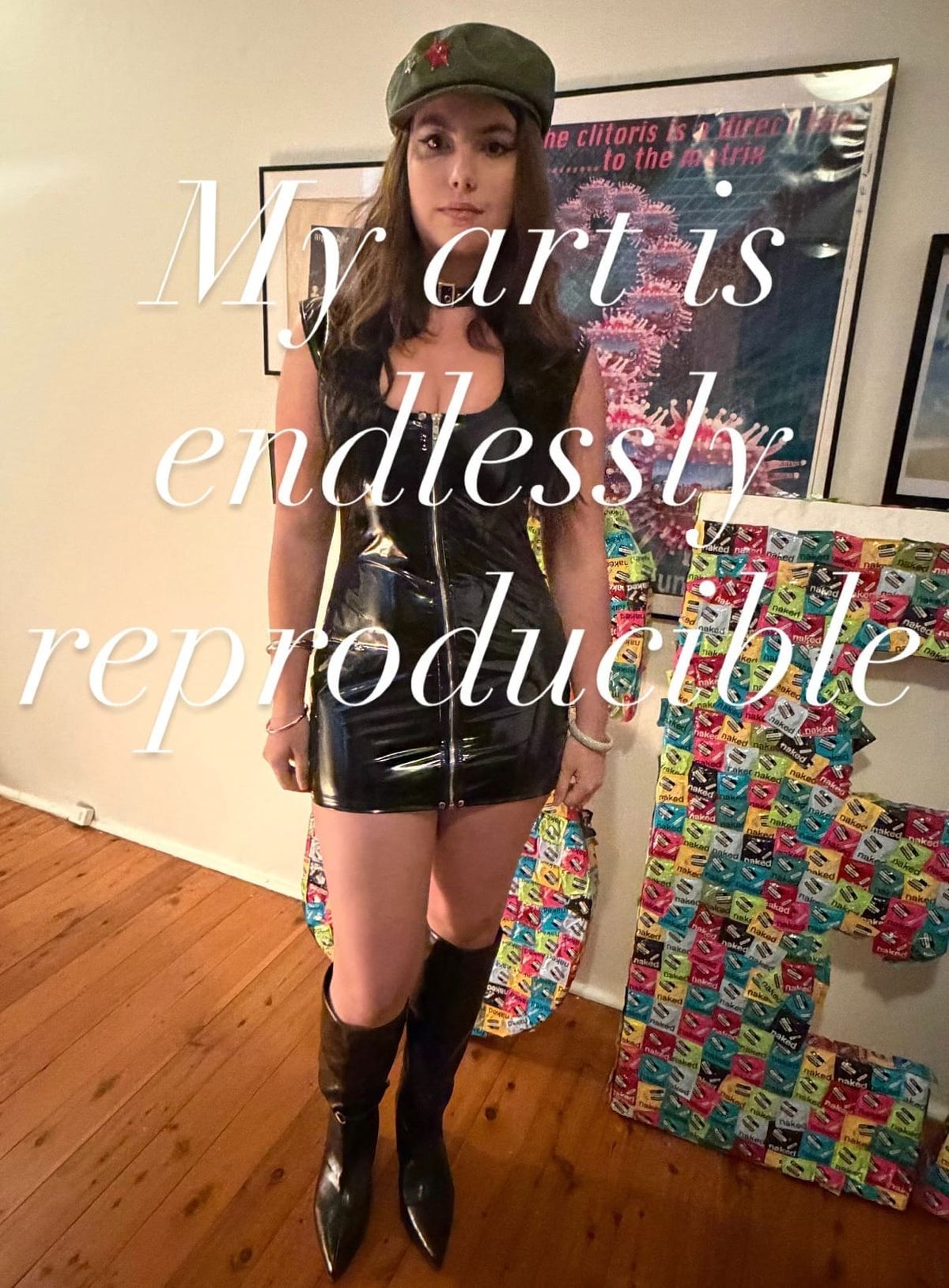
The given action went a little something like this. I confirmed with my ex-situationship that this idea would be appropriate for his party. To be honest, my collaborators were not too fond of this, as this severely negatively impacted the spontaneity of the event. Afterwards, my stylist friend and I bought some disgusting clothing from Kmart and Amazon: leopard print bralettes and pink crop tops, the tiniest denim shorts which will never be seen again, a horrible black-collared pleather dress, and horrifying Kmart knee high pleather kitten heeled boots. I had a third outfit that was something I’d worn to a Halloween party last year, a reference to another event in the past. To finish the outfits off, I wore clip-in extensions which did not match my hair colour.
We began our entrance to the party by walking up the street to his house. I was instructed by my team, consisting of my Creative Director friend, my stylist friend, and my friend and creative partner who was playing the role of Assistant Director. I was instructed to dance next to bins, to walk past the iPhone camera about five times at different speeds. I was instructed to stop walking as if I was in the military. We then began to film my entrance into the party.
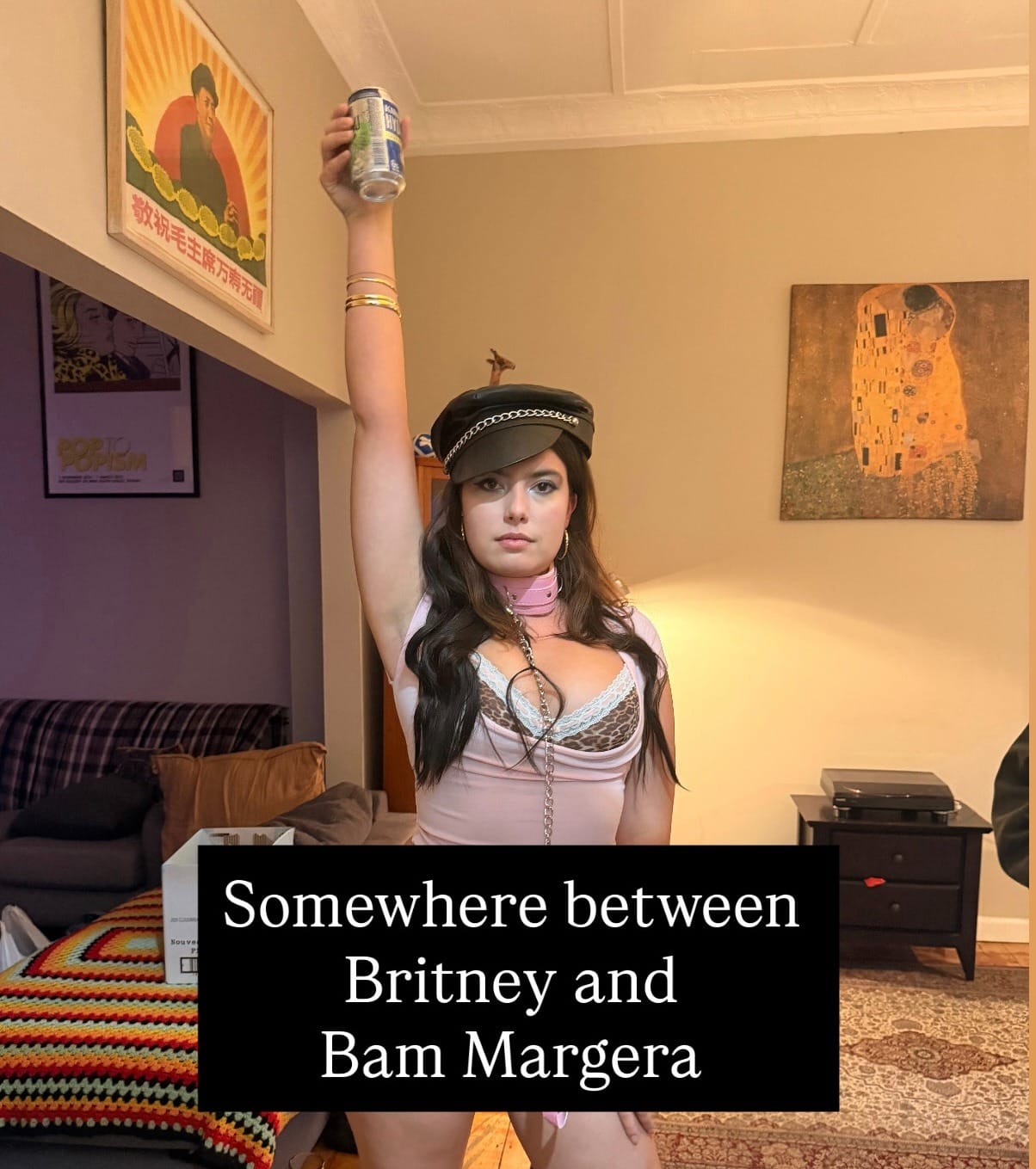
The song I filmed the music video for is ‘Piece of Me’. The ‘Piece of Me’ readymade replaces the lyrics of Britney’s ‘Piece of Me’ with similar circumstances of my life. I spoke of previous parties I went to where I was the subject of conversation, replaced the lyrics “I’m Mrs Lifestyles-of-the-rich-and-famous” with “I’m Mrs Lifestyles-of-the-Broke-and-Lazy”, and referred to the extreme volume of the bangles of my arms. The song itself refers to my previous behaviours at parties, particularly the kind of abnormal behaviour I would present at them. At some point, it happened that whenever my best friend and I entered a party or social event, neither of us could take it particularly seriously, and, thus, I engaged in some lady-jackassery. Jackass has always been a huge influence in the way I thought about the difference in gendered performance and transgressive acts; where young boys experienced Jackass as a rite of passage, young girls could never experience being a Jackass without some major form of transgression. The circumstances struck me as unfair. In my mass media revelry, I tried to find if I could find some overlap between the personas of Britney and Bam Margera. The answer lies in the relation to direction: that is how actions are ordered. My party performances seemed to mediate this in-between space.
After entering the party, I lip synced in front of my ex-situationship’s bookshelf. I then changed into my second outfit (the ugly pleather dress) and was filmed being escorted out of a room by my creative partner. At this point, the partygoers had migrated inside and did not react to this action. This is an ongoing theme with a lot of our party actions. When they take place, they do not get addressed. Later in the night, though, they are always addressed as a point of reference. We enjoy this, because it reaffirms the referentiality of the objects we produce.
We then changed into the final outfit: my previous Halloween party outfit. We filmed me flicking my hair in and out of the water in his bathtub which we half filled with water. It is the middle of winter in Australia. It was pretty cold, but I put a jacket on. We then filmed me exiting the party, holding my hideous boots as I walked barefoot down the streets of Sydney’s Inner-West.
Here is the audience response. Some guy asked us if we were doing a “Weird Al Yankovic” thing. We informed him that our work has absolutely nothing to do with parody, even if it is funny. As always, I simply said that the artist I am most similar to is none other than Rrose Selavy. My friends then asked who they were meant to be, what music video they were dressed up as. They were asked this a lot, and they confirmed that they were not dressed up as a video but rather they were creating a music video, and thus did not need to dress up. There was a lot of laughter at the events’ expense, their interpretation of my music video as some kind of serious attempt to be sexy. All valid audience responses, as they were misinterpretations and thus were necessary as constitutive of the social fabric which produces my music video. A friend at the party joined the crew at one point. I left parts of my costume around the house throughout the night (which I collected at the end of the party). When asked about them, I referred to them as sculptures and found object art.
Is my work autotheoretical/autofictional? I often find myself asking this. Autotheory or autofiction is typically conceived in the terms of the imposition of the actual-personal into theory or fiction. Alternatively, if my work is autotheoretical or autofictional, it is a reversal of this process. I conceive of my life in the terms of theory. This is almost a pathology at this point; every action, even in jest, is a manifestation of some concept. In these actions, I treat my life as if it were fiction itself. If contemporary art requires risk, the risk I take is the freedom to treat my life creatively, in the sense that it itself is an artwork. In these actions which break the continuity that we expect our life or life as filtered through our subjectivities to hold, I can collapse the distance with which we separate life from art. So whilst I play with elements of things that happened to me before in these actions, I can collapse these past events into a historicity contained within the art-action.
I want to end by meditating on women’s body art a little longer. Performance artist Valie Export, who sadly passed earlier this year, wrote a particularly exceptional essay on feminist performance art titled ‘Aspects of Feminist Actionism’. She argues that women have a history of violence imposed on them which forms the subject's identity through pain. She argues that the address of this in art is not sadomasochistic, but the expression of a “historical scar”. Most compellingly, she considers painful women’s body art not as some kind of expression of “abnormal drives”, but a confession publique, which expresses the pain of their history. In this way, my life-performance refers to my own history as a confession publique. It is for her, and for the address of women’s material history at the level of the everyday.
Read more of Jess' work at jessisonline.substack.com.