University of Wollongong undone
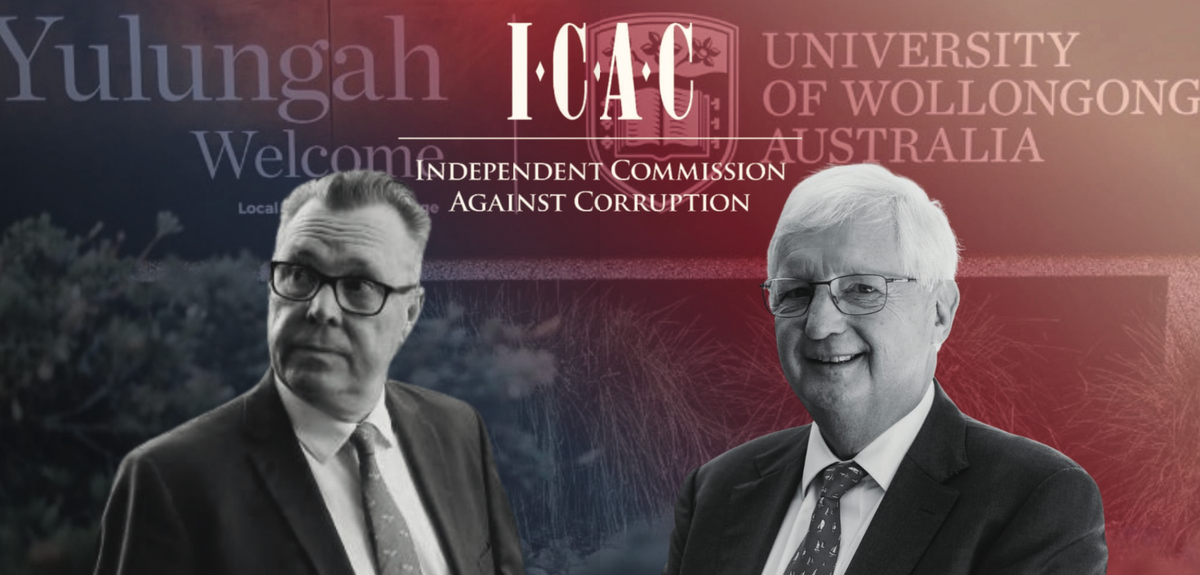
In late 2025, the NSW Legislative Council held its second inquiry hearing into the governance of universities in the state. In this particular hearing, the upper house committee focused on the University of Wollongong (UOW). Former Chair of the University of Wollongong WHS committee and CPSU delegate Lisa Simmons revealed to the committee that the NSW Independent Commission Against Corruption (ICAC) was investigating UOW after she had made a disclosure to the corruption watchdog.
Throughout this segment of the hearing, the Chair of the committee Labor Member of the Legislative Council Sarah Kaine conferred in hushed tones with committee staff on how to proceed given the extraordinary evidence tabled. Eventually, the committee took a brief sidebar as they sought advice on what questions could or could not be asked.
Independent media outlet Michael West Media revealed that a week prior to the parliamentary hearing, ICAC officers seized laptops at the University of Wollongong as part of the investigation.
Half a year later on 2nd June, the corruption probe announced a public inquiry as part of their investigations against the top brass of UOW — an investigation the watchdog dubbed Operation Scandi.
At the heart of this investigation are three figures. Chancellor Michael Still, businessman turned one-time University chief; Interim Vice-Chancellor John Dewar, who is also a partner at the consultancy firm KordaMentha; and governance chief Alyssa White.
The first allegation the ICAC is investigating is whether Chief Governance Officer and Secretary to UOW Council Alyssa White intentionally and repeatedly subverted recruitment processes to benefit her friends and associates, including previous colleagues from the University of Sydney and her high school friends.
A related allegation is her role in creating a new executive position earmarked for herself, Vice-President (Strategy & Executive Affairs). This promotion would have come with a $50,000 pay rise while hundreds of UOW staff were sacked.
However, the cronyism of a university bureaucrat pales in comparison to the second and third allegations which Chancellor Still and Interim Vice-Chancellor Dewar play an integral role.
The second allegation is whether Still, White, or any other university staff, influenced the award of work to consultancy firm Aspirall, and bypassed proper procurement processes in the process.
UOW engaged Aspirall in 2024 to facilitate focus groups in their search for a new Vice-Chancellor, an engagement that cost the university $49,600. In 2025, UOW once again engaged Aspirall to conduct a workshop for university leadership costing $74,450.
Aspirall founder Tanya Diesel met Still in 2004 and were suggested by the ICAC to be by all definitions friends. However, they would each contest this and describe their two-decade long association as being a “friendly professional relationship of, you know, a high-level kind” by Still and a “long-term business association” by Diesel.
The consultancy work was funded through UOW’s $2 million “Council Discretionary Fund,” a fund that Still himself played a role in setting up. UOW procurement policies required any work that would cost more than $20,000 to undergo a tender process, which was not followed.
Most egregious is the third allegation concerning KordaMentha partner and interim Vice-Chancellor John Dewar.
Concurrently to Dewar being recruited as interim Vice-Chancellor, UOW sought to conduct an enterprise-wide review of their operations putting a call for tender to three consultancy firms of which KordaMentha was ultimately successful in securing. Over 2024–25, KordaMentha was awarded over $3.8 million worth of consultancy work.
As a condition of his employment as VC, Dewar signed a secondary employment letter that prohibited him from influencing the university to engage KordaMentha, and if KordaMentha was engaged for consultancy work, he would not be involved in the process.
The NSW ICAC is Australia’s oldest, most powerful, and feared, anti-corruption body. Compared to Victoria’s Independent Broad-based Anti-corruption Commission (IBAC) — a corruption watchdog often described as a “toothless tiger” — NSW’s corruption probe has broad powers and the power to obtain evidence often inadmissible in court.
A key tool of the NSW ICAC is its ability to hold public inquiries, which attract considerable media attention. The NSW ICAC has felled multiple premiers, including Liberal Premier Nick Grenier who introduced the ICAC.
‘Transformative’ Cuts
The investigation comes after UOW suffered from devastating rounds of job cuts as part of the UOW Transformation program. In January 2025, UOW sacked 90 academic staff and disestablished four disciplines, to achieve $21 million in savings. Two months later, following the conclusion of KordaMentha’s review, UOW proposed culling 185 full-time equivalent positions for further savings of up to $26 million. In August, this proposal was revised down to only culling 100 full-time equivalent positions for savings of $15.8 million.
After Operation Scandi held its opening hearing, the UOW NTEU branch questioned the validity of the Transformation program. The branch said the “timeline of the allegations made during today’s ICAC hearing overlaps significantly with these job losses.”
“Amidst all the allegations we heard at today’s ICAC hearing, I was reminded of the story underneath it all, the stories of staff who have suffered, who have lost their jobs under chaotic restructures and processes,” NTEU UOW Branch President Dr Susan Engel said.
Following the extraordinary revelations over three weeks of hearings, held from 22nd June to 10th July 2026, at the corruption watchdog, the Illawarra Mercury reported that the National Tertiary Education Union (NTEU) called for workers sacked to be offered their jobs back and for UOW’s Council to be dissolved.
NTEU General Secretary Dr Damien Cahill described the situation as “the biggest crisis in the history of the university” and said UOW’s governance required a “complete overhaul.”
“All staff who were made redundant as a result of the tainted KordaMentha review should be offered their jobs back,” Dr Cahill said.
“The current university council needs to be dissolved and replaced with an interim body with a majority of staff, students, and alumni — people who understand the university and are invested in its success.”
KordaMentha’s Vice-Chancellor
John Kinley Dewar began his career as a law lecturer in the United Kingdom, followed by a string of Australian university executive roles at Griffith University, the University of Melbourne, and La Trobe University.
Dewar told the commission that he joined KordaMentha in February 2024 as a partner to develop KordaMentha’s nascent higher education consultancy practice. Later in 2024, former Chief Operating Officer of RMIT Dionne Higgins would join KordaMentha as a partner.
Following former Vice-Chancellor Patricia Davidson’s abrupt departure from UOW in April 2024, UOW sought to hire Dewar as an interim Vice-Chancellor for the remainder of the year until they could find a permanent Vice-Chancellor.
When John Dewar fronted the NSW parliamentary inquiry into the university sector in his capacity as a KordaMentha partner on 1st April, 2026, he faced a barrage of questions from the parliamentary committee about his time as Wollongong’s interim Vice-Chancellor. At the parliamentary hearing Labor MLC Sarah Kaine asked what involvement Dewar had in UOW’s decision to award work to KordaMentha. “None whatsoever,” Dewar told the committee.
In his answers to supplementary questions the upper house committee put to him, Dewar denied having any input into the proposal KordaMentha submitted to UOW. He also said he “did not provide advice in relation to KordaMentha's engagement with UOW.”
As it would turn out, the truth that emerged from the ICAC hearings was not so clean and tidy.
On 9th May, 2024, Dewar sent Chancellor Still a document where he outlined a proposal where Dewar would step into the role of interim VC and also facilitate work undertaken by KordaMentha.
Dewar wrote to Still saying “I propose that, linked to my appointment as Interim VC, KordaMentha be engaged to conduct a rapid diagnostic” of UOW that would be used to inform cost-saving measures including an “operating model redesign”, “reshaping the university’s course offerings”, a “cultural reset”, and a review of the University’s real estate holdings.
Counsel assisting the ICAC Emma Bathurst asked Dewar during the hearings if he had considered such an arrangement “could give rise to a conflict of interest between KordaMentha’s interests and the interests of the university?”
Dewar responded that he “thought that they could be managed… if they were declared properly.”
A few weeks later on 21st May, Still emailed Dewar, following a phone call, outlining the necessary requirements for Dewar to be employed as interim VC and for the award of work to KordaMentha.
Still suggested that Dewar be employed nine days a fortnight with one day allocated for his work at KordaMentha. Still also said that UOW would need to undergo a “proper procurement process” where KordaMentha would be included in a “small group” of firms invited to tender.
Dewar forwarded the “Strictly Confidential” email to his KordaMentha colleague Henriette Rothschild.
“It’s disappointing we have to go through a procurement process for the diagnostic,” Dewar wrote to Rothschild.
“There’s no mention of continuing support after the initial work. There’s no mention of eligibility to tender for further work.
“There’s a risk that this would become just a secondment to UOW with no benefit to KM, which I’m not interested in.”
On the substance of the emails, Bathurst put to Dewar “You considered it disappointing because it was different to what you’d originally proposed, being the package deal of you as the Interim Vice-Chancellor?”
Dewar answered in the affirmative. Dewar told the commission that he thought the procurement “would be a light touch process” and Still’s proposed process “felt a lot more than light touch.”
In another email Dewar sent Rothschild later in the day on 21st May, Dewar wrote “Michael says they have to go through a procurement process to avoid any probity concerns about the awarding of the diagnostic to KM. He says they are running it in a way that makes it very likely we will win it.”
“He suggests that the continuing support work could be done as an extension of the diagnostic engagement,” Dewar wrote.
When Michael Still fronted the commission, he denied ever having such a conversation with Dewar. Under questioning from counsel assisting Emma Bathurst and Commissioner Paul Lakatos SC, Still’s replies amounted to “I don’t recall.”
Still told the probe he spoke to Dewar prior to 21st May about the need for a procurement process.
When the commission pressed on whether Still did not recall having a conversation with Dewar on the 21st or if Still had no such conversation, Still remained equally evasive.
“My evidence is I didn’t say it,” Still told the ICAC.
Three days later on 24th May, Dewar wrote an email to his KordaMentha colleagues saying “Max [Rivadera] and I have put together a draft scope for a tender to be issued by the Uni of Wollongong at the request of the Chancellor Michael Still.”
Dewar told the commission that writing the scope of work that a consultancy would tender for was “less common in the public sector” but “not uncommon for clients to seek advice about the scope of work” in the private sector.
Bathurst asked Dewar if he ever sought out advice from consultancies on the scope of work that a university would put out to tender while he was an executive at other universities. “No,” Dewar replied.
When asked if this gave KordaMentha an unfair advantage in the procurement process, Dewar told the commission “there may have been a modest, small advantage but I, I wouldn’t say it was significant [advantage].”
On 27th May, Dewar sent the draft scope of work to Chancellor Still. Commissioner Paul Lakatos SC pressed Still on whether it was appropriate for a KordaMentha partner to draft a scope of work that they would then tender for. Lakatos suggested to Still: “Professor Dewar speaking to you via email and sending a draft scope of work was behind the scenes not a transparent or independent process, was it?”
“I think the process was completely independent. The fact that he’s sent that, I don’t, well, I don’t know what to make of it. I can’t recall reading it,” Still answered.
From 28th May to 3rd June, Dewar and Still negotiated the terms of Dewar’s employment including the wording of the secondary employment letter that managed Dewar’s conflict of interest as a KordaMentha partner.
The letter stipulated two conditions for Dewar’s employment as interim VC. First that Dewar would “not be involved in any consulting work to regional NSW universities or that would create a conflict with UOW” and that he would “not play a role in seeking to have the University [of Wollongong] engage KM to provide any services to the University, and that if KM is so engaged through any separate procurement process, you will not be involved in the management of those services.”
Evidence tendered at the ICAC showed that Dewar signed and emailed the employment documents at 11:25am on 4th June. Half an hour later, Dewar emailed Still asking “How’s the procurement process going?”
On 7th June, UOW sent the request for proposals for an enterprise-wide review to KordaMentha, Deloitte, and Partners in Performance.
Emails tabled at the commission showed that on 13th June Dewar offered his colleagues assistance in preparing KordaMentha’s response to UOW’s request for tender.
“It might be an idea to give you and the team a verbal briefing on what I am picking up as part of my induction,” Dewar wrote to his colleague Dionne Higgins.
An email showed that after KordaMentha finished preparing their draft response to UOW’s request for proposal on 19th June, Dewar’s colleague forwarded him an email containing KordaMentha’s draft.
Counsel assisting the ICAC Emma Bathurst asked Dewar if it was appropriate for him to have been sent KordaMentha’s draft proposal after he accepted the position of interim VC.
Dewar replied: “If I did I wouldn’t have accessed it. I did not play a role in putting together this proposal.”
“I don’t recall accessing the proposal, and I’m actually surprised that this would have come to me,” Dewar added.
Bathurst then showed the public inquiry emails that showed that Dewar made several comments on the draft proposal. Bathurst asked if the email shown refreshed his memory that he indeed had access to KordaMentha’s draft.
“I had completely forgotten. I have no, no recollection of this,” Dewar told the commission.
Dewar accepted that he did in fact review the proposal and make suggestions, but suggested that his feedback was “more cosmetic than anything.”
Dewar admitted to the commission that his feedback to KordaMentha on their draft proposal violated the terms of his secondary employment letter.
“I suggest to you that this mechanism was ignored by you in circumstances where you assisted KordaMentha in the preparation of its response to the RFP,” Bathurst suggested to Dewar.
“That’s an ungenerous way of putting it, I think,” Dewar responded.
KordaMentha ultimately won the tender, as a meeting on 2nd July of UOW’s tender evaluation panel determined. KordaMentha’s review began in earnest shortly after on 22nd July.
John Dewar’s term as interim Vice-Chancellor officially commenced on 22nd June, 2024. Evidence showed that over his term as interim VC, Dewar notified his KordaMentha colleagues of potential future consultancy work and sent UOW documents to his KordaMentha email account before forwarding it to KordaMentha colleagues.
Dewar emailed a KordaMentha colleague on 1st July notifying him of potential work, including a “HR capability review, a review of staff complaints handling, and some real estate advisory.” Four days later, Dewar sent the draft scope of work for the UOW human resources review from his personal to KordaMentha email, before forwarding it to his colleague Henriette Rothschild.
Counsel assisting the ICAC Emma Bathurst asked Dewar why he had sent the email. Dewar replied: “I must say, I don’t recall sending it but it’s clearly there.”
When Bathurst put to Dewar that this was an example of him influencing the award of work to KordaMentha, Dewar answered “It could be seen that way, yes.”
On 9th July, a KordaMentha analyst sent Dewar the finalised proposal in response to UOW’s request for an enterprise-wide diagnostic. Dewar replied the next day asking for the files to be sent as attachments as he could no longer access the KordaMentha sharepoint.
In September 2024, when UOW drafted an initial proposal for the “FutureUOW Change Management Proposal,” Dewar forwarded the draft paper to his KordaMentha email before relaying it to another KordaMentha colleague.
Dewar once again told the commission he could not recall why he had forwarded the email to his colleagues at KordaMentha and admitted this was another example of a breach of his secondary employment letter.
The hearings for Operation Scandi adjourned on 10th July, 2026. Counsel assisting the ICAC Emma Bathurst is expected to produce her report by 7th August with other parties given a chance to reply in the weeks following. The commission’s final report is expected to be due next year.
Editor’s Note: This article was originally published by the University of Sydney’s student newspaper Honi Soit.