On the remaining languages of UOW
It’s not a coincidence if you are not aware of the budget cuts that have swept our university off its feet for the past two years.
As of last week, ABC News reported that UOW cuts have soared past 270 job losses “after a $35 million revenue drop, partly due to federal visa and migration changes affecting international student numbers.” International students were blindsided on the 1st of March 2026 when the Labor government quite literally doubled the price of temporary graduate visas. Do we see the irony?
Staff, alongside the subjects they teach, have been dropping like flies. Faculties have been reduced from four to three, where the schools that remain somewhat unscathed are the two STEM focused. The previously known Faculty of Business and Law (BAL) and the Faculty of Arts, Social Sciences and Humanities (ASSH) are now painfully conjoined as the Faculty of Arts, Society and Business.
In UOW’s extremely vague Final Change Plan, they ironically state that the budget cuts aren’t solely about reducing costs but that they are … about reducing costs. They state: "This transformation is not just about cost reduction … [changes to] our operations and maintaining a sharp focus on non-salary expenditure, … will help put us on a more financially sustainable footing."
Students have expressed their concerns and discomfort over the cuts in their course as subjects with little to no correlation have been merged, making students feel as though they signed up (and are paying thousands) for a different degree to the one they chose originally. My English literature degree, for example, has merged several distinct eras into single subjects and have left the minimum amount of subjects possible to graduate with. That means that certain subjects I was planning on were taken away, leaving me with the only option of carrying on for an extra semester just to finish my degree. This will cost me thousands of dollars.
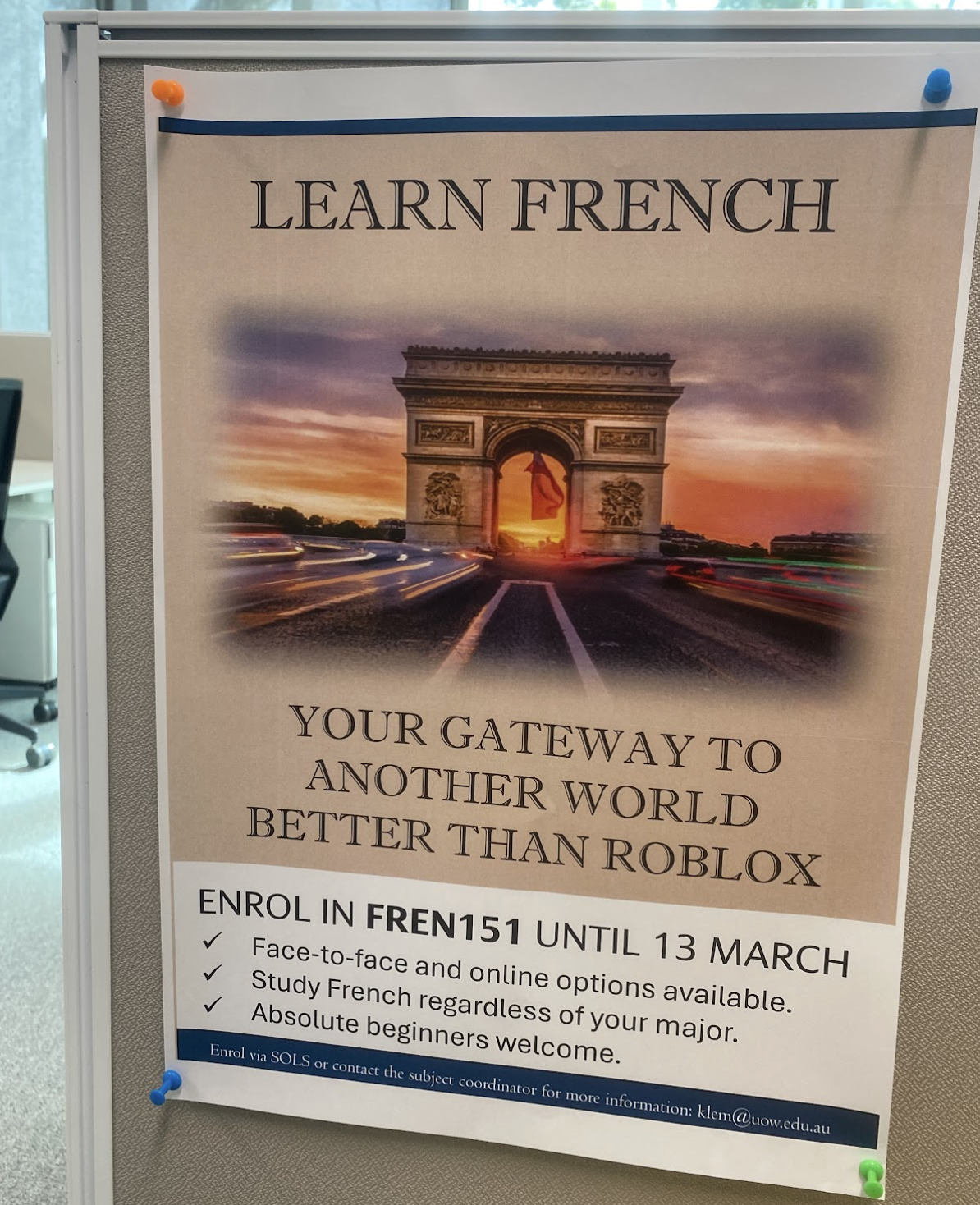
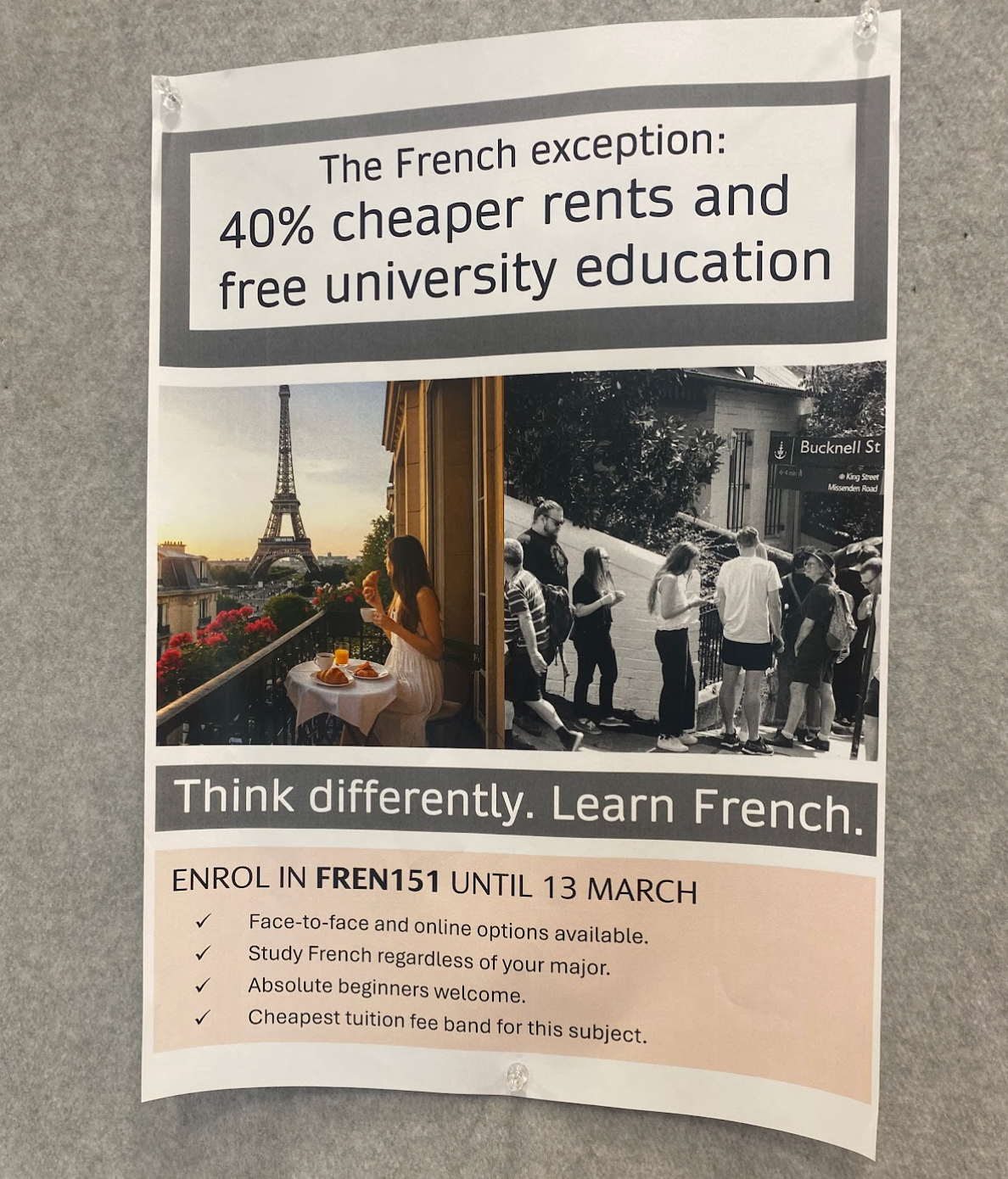
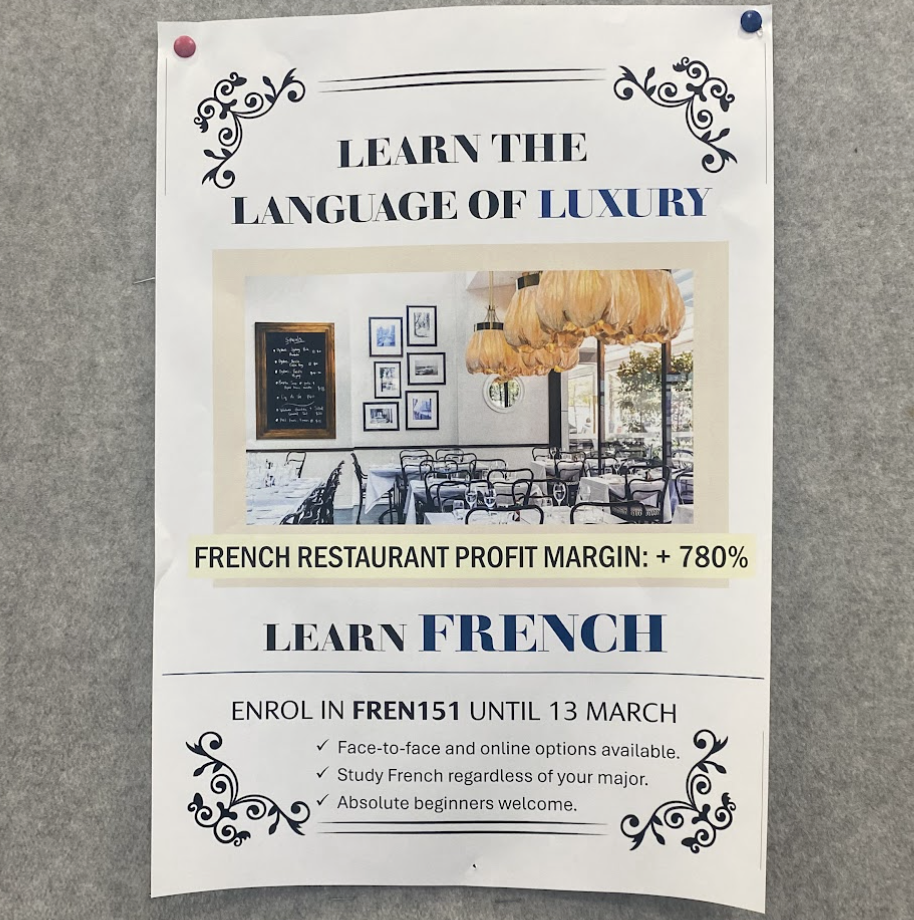
I hadn’t thought about these budget cuts since the new year started but since being on campus and seeing certain posters around, the cogs in my brain, rusted from the holiday break, began turning again. These posters featured images of cafes, the Eiffel Tower and the Arc de Triumph, with the headings like “LEARN THE LANGUAGE OF LUXURY” or “THE FRENCH EXCEPTION: 40% CHEAPER RENTS AND FREE UNIVERSITY EDUCATION” or “YOUR GATEWAY TO ANOTHER WORLD BETTER THAN ROBLOX.”
Although we already had very few languages (Chinese, French, Japanese and Spanish), our multicultural student population now has the choice of two languages. And despite the fact that our university has campuses in Asia and the Middle East, and is fighting for its life because of the lack of international students, UOW has chosen French and Spanish as the languages to keep.
In their recent appearance before NSW Parliament at the University Sector Inquiry, UOW took some questions on notice and responded to a question about their profits from international campuses. “UOW Global Enterprises (UOWGE) operates the University of Wollongong’s offshore education network, including campuses in Dubai, Malaysia and Hong Kong. These operations are strategically important to maintaining UOW’s global reputation and financial sustainability. UOWGE serves approximately 17,000 students annually across its global network.”
It seems a bit disrespectful to budget our Asian campuses as income for our university and then turn our backs on Asian languages.
What struck me though, were the elitist phrases used in the French posters. I could not restrain a sarcastic chuckle at the idea of French being the “language of luxury,” and taught as such during our cost-of-living crisis, our petrol spike, the wars, and the university budget cuts, as if we’re the right people to be talking about “luxury”.
I reached out to fellow students, academics and staff, who wish to remain anonymous. They overwhelmingly shared my thoughts: that these changes would whitewash our university's multicultural legacy.
I can’t help but think how Euro-centric and avoidant this decision appears, especially since the promotional posters show how luxurious life could be through these white languages. The target audience for these posters could be argued, however it’s the lack of representation for our global south countries that should be discussed.
I discussed the budget cuts more broadly with students, academics and staff.
Students mentioned how they felt targeted for studying their passion rather than following a course that focused on the betterment and interest of the nation. But what’s worse is that most students and friends I spoke to were unaware of any changes, whether that was from being a new student or just uninformed. Both groups wished for better communication and options for their courses.
Academics noted how administrations have steered them to business-like attitudes towards students, where student numbers to fill classes are more important than the relationships formed with them. They noticed how students have been reluctant to reach out like they once did because of the changes. They mentioned how they feel constrained to following orders to continue their academic life and therefore detached from student life.
Staff mentioned how the budget cuts have directly affected their campus businesses and productions, following on from the fact that students are less interested in events and disconnected from campus life.
The French faculty did not reply to my requests for a comment.
All in all, each group I spoke with shared the same experience of feeling alone and left in the lurch, with no other option but to continue down the path laid out for them. I hope this publication can bring some of us together once again.