Review: Cicada explores the becoming and undoing of an artist’s trauma
The drone of cicadas fills the air. Your icy pole melts in the throbbing summer heat. You’re eight years old, and the world feels so big, and you feel so small. Where else is there to turn but the comfort of art? Drawing with crayons helps you through, it’s true, but the more you create, the more you realise that the world never gets smaller, and you never really get bigger. The thought terrifies you. You lash out, destroying everything that you once loved, and once loved you back. All you are left with is cut-up pieces of your art, and those damn cicadas.
How can someone balance their artistic goals with their personal goals? How can we truly create art in a capitalistic world? Is there any point to creative expression when it relies on the opinions of so-called experts? These are just a few of the heat-warped and fourth-wall-breaking questions that Tegan Ware’s Cicada asks. The piece is introduced as a retrospective on an unnamed artist’s works, found in the Wollongong Art Gallery’s archives. Two curators attempt to guide the audience through the Artist’s (as he will henceforth be called) life. Some dismiss the Artist’s work as pretentious and rudimentary. Others call him a “once-in-a-generation talent.” But what cannot be disputed is the Artist’s tragic childhood, beginning with the death of his half-sister, and ending with the death of his mother. As we timejump between the Artist’s life as a child, as a young adult, and as a social pariah, we uncover just how much his trauma has affected him. As he faces addiction, relationship struggles, and a massive scandal that ends his career, Cicada demands we reckon with how we critique art, and questions how far we can push the line between art and artist.
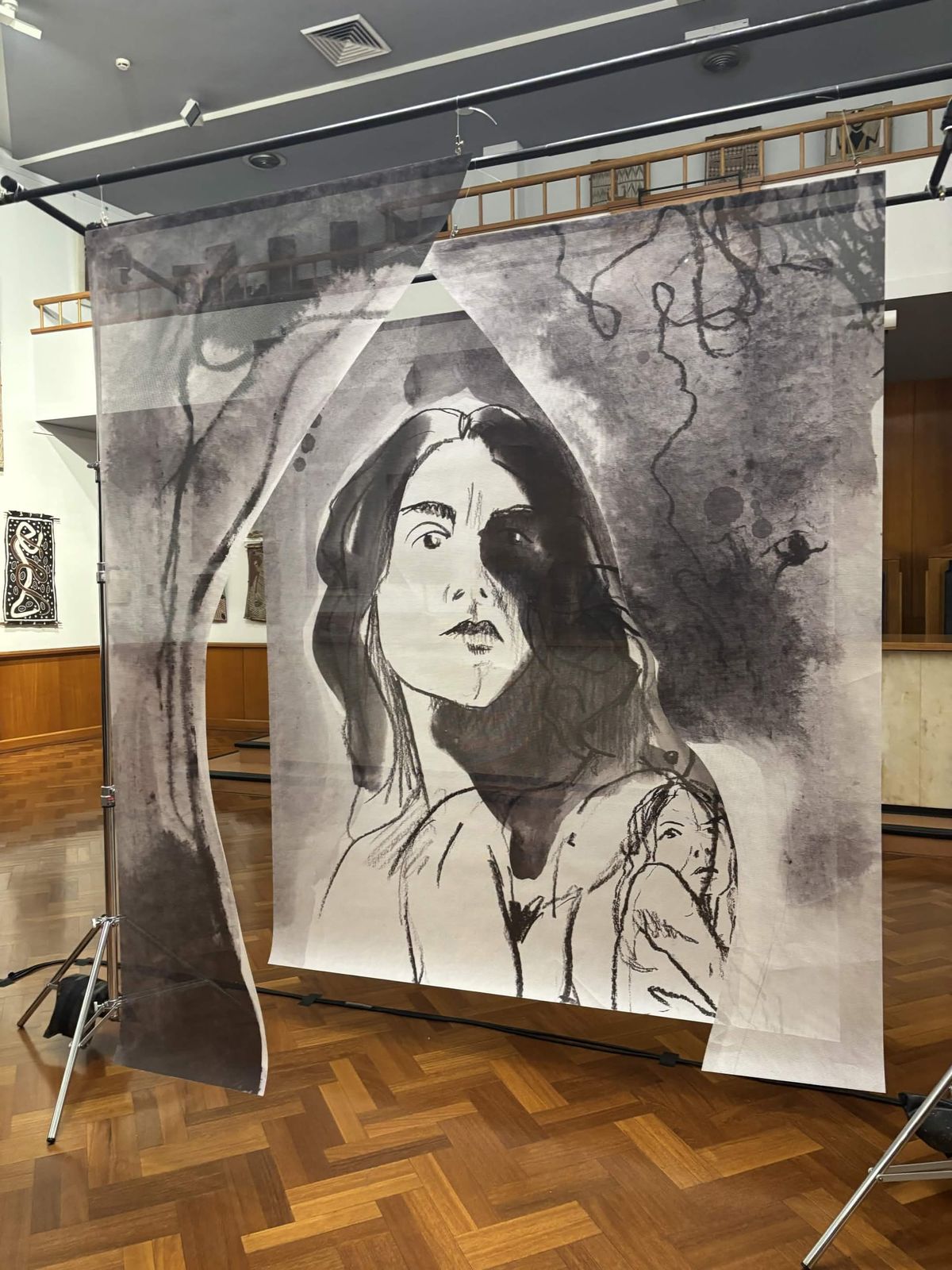
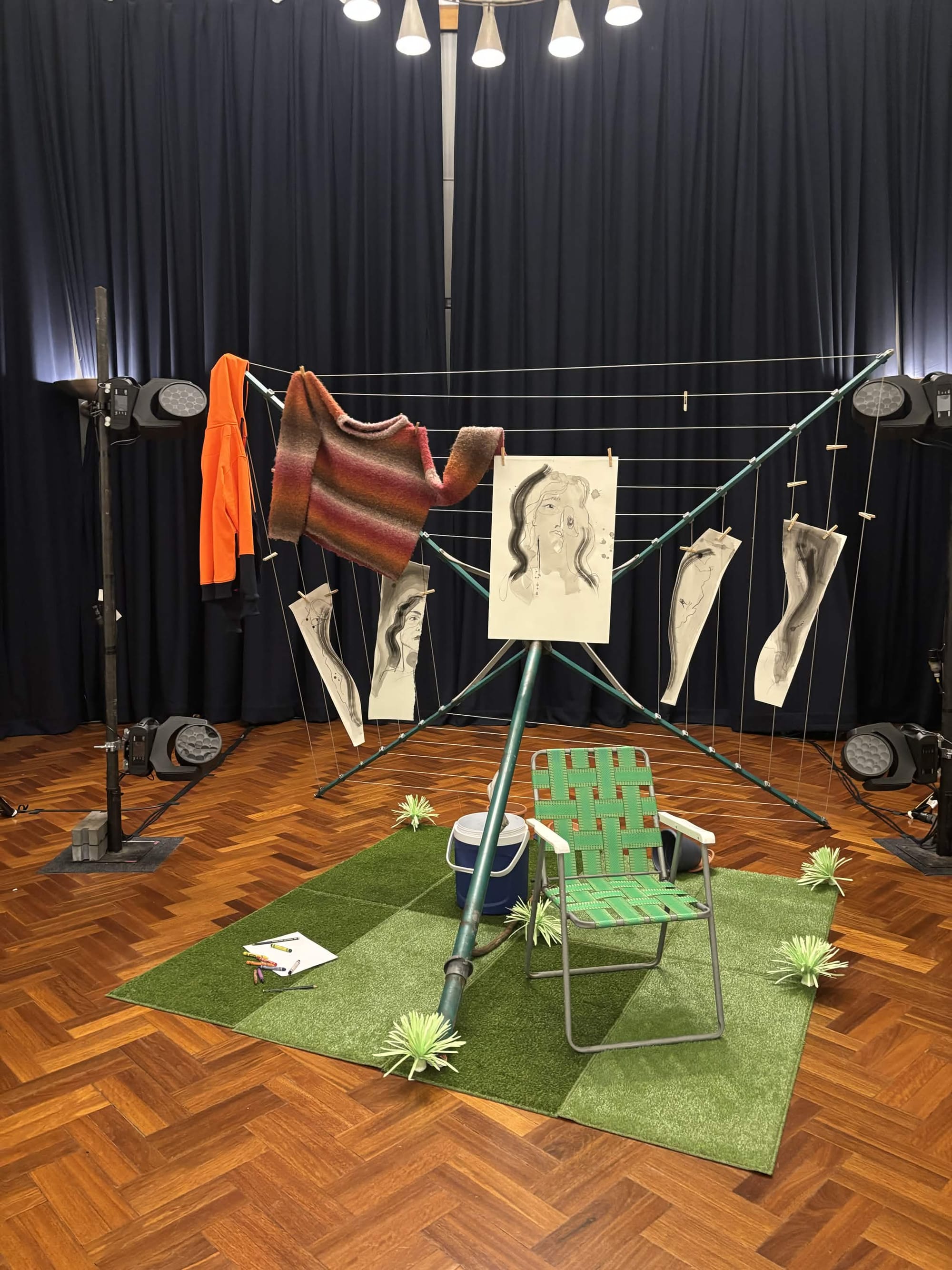
I had the pleasure of interviewing Ware about Cicada about a month ago. When asked why she decided to stage the production in an art gallery, she said: “The play has always been about visual art and the experience of making things, so that has always been at the forefront of how we've been creating it.” Indeed, the play emphasises visual art in its staging. There is a Hills Hoist lying on its side, with fake grass spread out beneath it; a piece of blank paper and crayons; a lawn chair. Pinned onto the clothesline are torn-up pieces of what could be a finished drawing, as well as a fluffy jumper and a fluorescent orange tradie hoodie. Opposite the Hills Hoist is a large drawing of several women’s figures, displayed in torn pieces of sheer fabric. In the middle of the stage stands a red wheelie bin.
The audience is seated on either side of the stage, as if we were witnesses in a courtroom hearing, silent and judging. Cicada takes pride in its mind-bending ability to force several different perspectives, no matter which seat you sit in. The notion of judgement rings heavily throughout the performance – Cicada shows you how the Artist got to such an extreme point, but it does not show mercy in its condemnation of his choices. It encapsulates both the absurdity of shunning an Artist’s oeuvre due to their personal life, and the danger of, as an artist, relying too heavily on the public’s opinion.
Standing out as particularly incredible was the sound design of the play, created by Frank Dwyer. Upon entering the space, the ambience of cicadas whirring was immediately noticeable. Eventually, you stop hearing it at all, since it fades so perfectly into the background. The music alternates between a calming ambient synth and a jarring distorted jumble of what it used to be. Towards the end, the distortion of the music to the point of audial overwhelm is astounding and shocking.
In terms of the lighting, designer Corey Potter uses several vastly different colours to depict its moods: pink and yellow to indicate a classic Aussie sunset, contrasted with a pale sickly blue as the Artist grows older. These choices ultimately contributed a large part of the audience’s interpretation of the Artist’s life and personality.
My main takeaway from Cicada is how expertly and relatably it expresses the commodification of modern art. The Artist only ever seems happy when his art has sold for thousands of dollars – otherwise, he is demotivated, lethargic, and manic. Towards the end of the play, we find that the Artist’s final exhibition is also named Cicada. He explains that he sees the artist as a cicada: “we are born desperate to make art [...], we live for a very short time, and then we die, leaving a husk of ourselves behind.” It’s an apt summary of Ware’s central message. As artists, we often pour so much care and personal experience into our work, that eventually we cannot contain it in a single body. We have to grow. We have to leave summer behind.
You can grab your tickets for Cicada from the Merrigong Theatre Company website for both the 28th and 29th of August. Experience for yourself a fantastic example of Australian theatre, and its promise of a bright future for the Wollongong theatre scene.