The Final 9: Film Review Fridays Special Feature
It's time for the Final 9 – these are the films that, in 2025, have defined us.
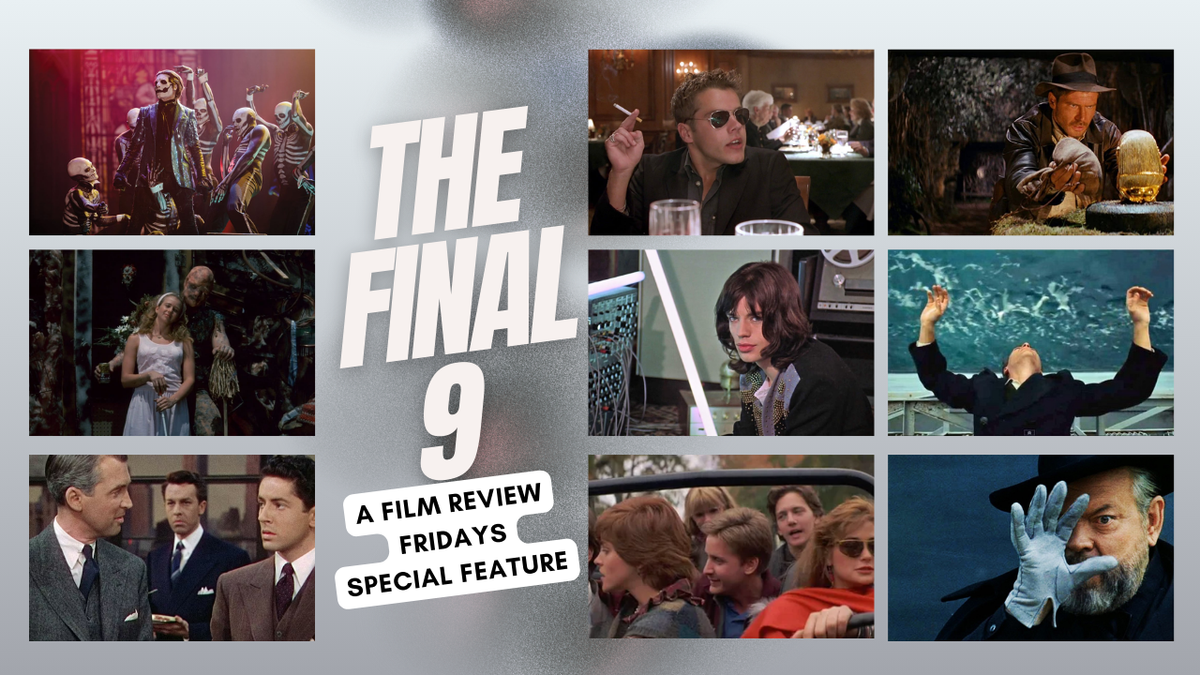
The end of the year is almost upon us, and that means it's time for the Final 9 – these are the films that, in 2025, have defined us. Whether they made us cry, made us laugh, made us think or in some way simply changed us, these films stuck with us, and now, our three reviewers each recap the top three films that made their years.
With bittersweet emotion, we'd also like to announce that this piece marks the end of Film Review Fridays. After two incredible years of reviewing, we've collectively decided to bring this project to an end, and move on to new things. It's been an absolute pleasure to be involved with this team, though, and we'd like to say thank you to everyone who has read and supported the work of the Film Review Fridays team since 2023. If you've enjoyed these reviews, we hope you'll keep an eye out for us in the future.
"And in case we don't see ya, good afternoon, good evening, and good night!"
– Mason, Daniel and Emma
Mason's Final 3
Rite Here Rite Now (2024), dir. Tobias Forge and Alex Ross Perry
Concert films are an underutilized genre. Sure, you could make the argument that they're fine as they are. All a concert film needs is a charismatic musician, a stellar backdrop and top quality songs. So much more could be done, never has that been more demonstrated than with Ghost’s ‘Rite Here Rite Now', which not only fulfilled the mentioned prerequisites but also implemented sketches that contribute to the band’s lore.
Tobias Forge is the band's frontman and main songwriter. He's become an icon in Swedish Metal through not only Ghost but his previous bands, Repugnant and Crashdïet. With Ghost, he was able to go solo, retaining full anonymity (until a court case forced him to reveal himself) and taking on the persona of 6 “Papas” (satanic Popes). Each album gave Forge a new Papa and new personality, often via killing off the previous Papa onstage. In addition, Forge put together lore to explain the relationships between the Papas, explaining that the band was formed by Papa Nihil in the 60s and that each Papa Emeritus (of which there are 4) are his sons. ‘Rite Here Rite Now’ takes place during Papa Emeritus IV’s tenure and the sketches that take place throughout the concert deal with his eventual exit as frontman.
Forge plays Emeritus IV as insecure and snarky towards his parents but also prideful and joyous towards his audience. Comedically, he could fit right into ‘The Office’. He's relatable, sometimes tripping on his words, but is deeply passionate about the music.
Alan Ursilo plays Nihil as particularly religious and by-the-book. He establishes himself as a solid father figure to IV, despite not being around as much. His greatest scene is during the song ‘Mary On A Cross’, when we're treated to an animated music video retelling the love story between Nihil and his partner Sister Imperator.
Because the concert filmed was part of the Re-Imperatour, ‘Impera’ is the album focused on, but many Ghost classics are performed as well. All 3 of Nihil’s songs (‘Mary On A Cross', ‘Kiss The Go-Goat’ and ‘The Future Is A Foreign Land') as well as 3-4 songs from each previous album, all bases and Papas are covered.
‘Rite Here Rite Now' shows that other concert films have a lot more room for improvement and innovation. The film not only provides an experience not many are able to have, but also explores a heartfelt family dynamic where IV’s parents prepare him and reassure him that though he won't be the frontman forever, he will always be remembered.
The Toxic Avenger (1984), dir. Lloyd Kaufman
Since 2008, with the release of ‘Iron Man', the superhero film genre has dominated the box office and arguably every year’s cinematic catalogue. In response to the clear overwhelming nature of the genre, many anti-superhero films and television series have been developed, most notably Eric Kripke’s ‘The Boys’, Matthew Vaughn’s ‘Kick-Ass’ and Macon Blair’s ‘The Toxic Avenger'. The ‘Toxic Avenger’ franchise is one that I particularly take a shine to, as it satirises the common trope of gaining superpowers via radiation in a more horrific, slightly more realistic way than most superhero films do. Really, am I supposed to believe the Hulk just turns green with no symptoms of radiation poisoning at all? This year, I was able to watch the original classic from 1984, directed by Lloyd Kaufman who founded Troma Entertainment, a studio that cemented its reputation through Z-movies (top quality so-bad-its-good movies).
Unless you're a dedicated viewer of ‘The Boys’, I should warn that ‘The Toxic Avenger' is not for the faint of heart. The killings are gory, the language is vulgar and there's a scene featuring vehicular manslaughter in the first 10 minutes. But if you can stand – and maybe even enjoy – the repulsive places this film goes, I would highly recommend it.
The film follows gym janitor Melvin Ferdly, the target of ridicule by a local gang. During a prank, Melvin accidentally stumbles into a vat of acid, which horribly disfigures him and turns him into the titular hero (also known as Toxie). Melvin uses his newfound powers to not only get revenge, but to save Tromaville from criminals and political corruption. Along the way, he falls in love with Sara, a blind woman who he saves in a hostage situation.
Mark Torgl plays Melvin before his transformation and plays almost every stereotype of geek. He shivers in fear, he has a toothy smile and has the vocal cadence of a hillbilly. It's a hilarious portrayal that satirises many superheroes’ alter egos.
Mitch Cohen plays Melvin as the Avenger with Kenneth Kessler providing the voice. Cohen’s physical acting is reminiscent of Schwarzenegger’s Conan portrayal, swinging anyone and anything out of his way, which thankfully differentiates Toxie from obvious parody targets, The Thing and The Hulk. Kessler completes the portrayal with a bold Superman voice, but luckily with all the other features of his portrayal, doesn't pull Toxie away from his own originality.
I'm glad to have watched and fell in love with ‘The Toxic Avenger'. It's strengthened my tolerance for terrible films and love for creatively explicit content. I'm able to come out of the theatre and laugh, not moan about how I wasted $30 on a movie ticket (‘A Big Bold Beautiful Journey’ – that's all I'll say). ‘Toxic Avenger' makes me want to get my hands on every single Troma release, see how far the rabbit hole goes. Next on my list to track down: ‘Tromeo And Juliet'.
Rope (1948), dir. Alfred Hitchcock
I’ve never been much of a Hitchcock fan. The first of his films I ever watched was ‘Psycho’ and while I could enjoy it for Anthony Perkins’ captivating performance as Norman Bates, it ended up never getting a rewatch. This year, I decided to put aside any feelings of underwhelmment and delve head-first into Hitchcock’s filmography. As expected, a few didn’t catch my fancy, but the first that really kept me on edge for the entire runtime, the first that changed my opinion on Hitchcock, was ‘Rope’.
Made in 1948 and based on the 1929 play of the same-name, ‘Rope’ follows Brandon and Phillip as they host a dinner party for their friends while hiding a dark and disturbing secret: they committed murder only half an hour before the party started. Their victim? Another member of their friend group. Their motive? To see if they can get away with it. The corpse’s location? Inside the very cabinet the dinner is laid on top of. It’s hard not to get caught up in the excitement, feeling as if you’re in cahoots with Brandon and Phillip. I found myself constantly watching the cabinet, waiting for a catastrophic mistake like someone seriously hurting themselves bumping into it, with the bumper left thinking “what the hell could be in there”? The film being done in 10 long takes (made to look like a single shot) only amplifies that feeling, cementing the idea that anything can happen and that once the body’s discovered, there are no redos.
As the party goes on, the friends all keep wondering where their friend David (the dearly departed) is. Brandon is proud and confident they’ll not only walk away free, but also earn the admiration of their mutual friend, Rupert (played by the ever-suave Jimmy Stewart), while Phillip slowly degrades over time, becoming more and more nervous someone will catch on and send them right to prison. I believe the film (and of course, the play) is a great litmus test for people who hypothesise how they’d get away with murder. After all, we’ve all had that one friend who’s talked about it (in my case, that was me), and clearly Hitchock was that one friend, as his previous film ‘Shadow Of A Doubt’ featured two friends who had constant conversations about how they’d murder each other in a chillingly academic tone.
John Dall is hauntingly charismatic as Brandon, working the room effortlessly and even pushing his luck playing matchmaker at one point. His psychology is deliciously mysterious. It’s hard to distinguish where his pleasure lies. Does it lie in the opening scene where he strangles David to death? Does it lie with the thrill of the game or does it lie with his accomplishment of undetected murder? Dall does a marvelous job not revealing any of these as the answer, which I believe is what makes his performance so captivating.
On the opposite end of the spectrum is Farley Granger as Phillip, who portrays a ticking time bomb. Phillip pulls you in more than Brandon; you’re left on the edge of your seat, waiting for Phil to scream bloody murder and pull the curtain back to reveal their diabolical work.
Though it wasn't positively received at the box office on its first release, I'd happily go to bat for this film. It's got a simple premise with dark consequences; the bomb could go off at any second. If you were caught with a dead body in your cabinet, how would you get away with it?
Emma's Final 9
The Rules of Attraction (2002), dir. Roger Avary
The Rules of Attraction, Bret Easton Ellis’ second novel, was published in 1987. Its awe-inspiring film adaptation, released in 2002, was the third time one of Ellis’s novels had made it to the big screen, and the first time it had been done in such a way as to capture what the author called “the sensibility of the novel in a cinematic way.” Fittingly for what I’d call Ellis’ most impressive book, the Roger Avary-directed The Rules of Attraction is also one of the most extraordinary and unique works of cinema I’ve ever seen.
At a basic level, it follows three students – Paul, Lauren and Sean – at the fictional Camden College in New Hampshire. Their intertwined lives revolve around having casual sex, doing drugs, not attending classes, and making each other’s days hell: Paul is in love with Sean. Sean is in love with Lauren. Lauren is in love with her old boyfriend, Victor, and Victor is in love with himself.
Obviously, no one ends up happy. But boy, is the path to this inevitable doom fun.
As Sean Bateman (younger brother of Patrick Bateman, the serial killer protagonist of Ellis’ notorious American Psycho), James Van Der Beek epitomises humankind at its worst – violent, unforgiving and deadset on getting his way whatever the horrible consequences. Yet, Bateman’s threatening and almost vulgar character is intoxicating, and he’s impossible to look away from.
Meanwhile, the blisteringly fierce but fragile Lauren Hynde is played by Shannyn Sossamon, and her performance is without question the movie’s standout. Empathetic and unusual, there’s an astonishing depth and wild magnetism to her character that elevates the film far above any normal college romance.
The third lead role, Paul Denton, is well-handled by the scarily perfect-looking Ian Somerhalder. Although the character seems deceptively ordinary, Somerhalder plays Paul with an untouchable, enigmatic quality that might actually be the most interesting part of the film. In a world of excess and emptiness, he’s the only one that makes you wonder if there’s something more below the surface.
Like the sprawling, agonising ouroboros of the film itself, its characters draw one in with fearful immediacy. In the pull of these twisted heroes one can't help but want to cry, or get drunk, or throw something across the room just to try and settle the restless, heady intensity of feeling that The Rules of Attraction instils.
With a great soundtrack, mind-blowing cinematography that tells ten stories in a single angle, an almost hallucinatory but hypnotic air to it, and a non-linear enough narrative that one can sink totally into the story without fear of being pulled out by the demands of plot, it’s not a film you can watch without being changed. In being also the best adaptation of a Bret Easton Ellis novel – and, I’d even say, possibly one of the single best transformations of a book to a film ever – The Rules of Attraction is a cinematic masterpiece unlike anything you will have seen before.
Performance (1970), dir. Nicolas Roeg and Donald Cammell
Before I even start this review, I need to make it clear that no words I can write will truly be able to do justice to this film. Without a trace of irony, I believe I saw God, actual God, when I watched Performance, and in very significant ways I am a different person after experiencing this film to the person I was when I first sat down to watch it. While I know it’s a cliché, words can’t express the effect this film has had on me, or the certainty with which I believe you will never, ever encounter another piece of art like Performance.
But I have to try and write this, because if I can share Performance with anyone, and let someone else experience the life-changing magnitude of watching this, it might be one of the most important things I ever do. So. Where to begin? Performance, directed by Nicolas Roeg and Donald Cammell and released in 1970, stars Rolling Stones frontman Mick Jagger in top form as reclusive, mercurial rockstar Turner Purple. Turner lives in London with two women, Lucy (Michèle Breton) and Pherber (60s it-girl Anita Pallenberg, who is perhaps best known as the muse and partner of Jagger’s Rolling Stones bandmate Keith Richards). Living off Turner’s royalties, the three take psychedelic drugs, have sex with each other, and lead aimless, bohemian existence in the once-grand townhouse.
With the introduction of a fourth person into the house – gangster on the run Chas Devlin, played by James Fox as you've never seen him before – this unreal world is shattered. Drawn in by Turner as violently as viewers are to the mesmerising yet impenetrable film, Chas quickly and explosively loses his sense of self and reality and becomes inextricably absorbed in Turner’s orbit.
Viewers, too, are pulled into Turner’s exquisite orbit. So subtly that we don't notice until far too late, we are dragged headlong into an illusion whose crumbling will ultimately snap something inside us. As Chas falls apart, the story and cinematography becomes slowly more disjointed, and the universe whose grip on us has become inescapable is able to, without us realising, tear pieces from us until our own sense of identity and reality is razed viciously to nothing.
Performance is the first film by which I’ve felt truly, deeply humbled. Although the feelings I had for it were beyond even rapture, for some time after watching Performance I also felt ashamed – who was I to try and exist as a self when that meant asserting my worth alongside something so extraordinary as Performance? What was the world, to be what it is now when it had once been like Turner’s?
With time, those feelings have faded, replaced only with total awe, and the magnificence of Performance no longer seems menacing. But its power isn’t any less, and from my own experience I can’t believe there could ever be something more transformative or worthwhile to watch. If you’re ready, this film will change your life.
*I would never normally do this, but I’d like to also link my Letterboxd review as an insight into everything that was going through my head after I watched Performance, and my immediate sensations of it.
St. Elmo’s Fire (1985), dir. Joel Schumacher
There are many reasons why one might love St. Elmo’s Fire. The profoundly believable characters, for one. The classic Brat Pack cast lineup, for another. Or what about something as simple as the phenomenal soundtrack?
Then, there are also many reasons why I, personally, love St. Elmo’s Fire. There’s the fact that it – a story about new graduates – was the first film I watched after I finished my last uni exam. There’s that at various stages of my life, I’ve related on a spiritual level to different characters and their struggles, and found comfort in feeling seen by the film. And then there’s that I cried on my last rewatch, which is just so far beyond what any ordinary film can do that it’s incredible.
But whatever your reasons for loving it, St. Elmo’s Fire certainly has a lot going for it. In it, seven college friends – Leslie, Alec, Kirby, Kevin, Jules, Wendy and Billy – enter the ‘real world’, with careers, commitment issues and existential angst all factoring in as they try with varying levels of success to work their lives out. At times, they drift apart, but through fear and joy are always pulled back together and to their local bar – St Elmo’s – where, it seems, everything might turn out okay after all. With an unflinching, sober gaze, the film explores the monumental pressures and pains of young adulthood, but also offers a heartwarming and frankly redemptive look into the beauty and power of friendship through everything.
As peak Brat Pack fare, the cast of St Elmo’s Fire is inevitably fantastic. Almost unrecognisable to his reckless delinquent Bender in The Breakfast Club (the other definitive Brat Pack movie), Judd Nelson is straight-laced politician Alec, whose long-term relationship with architect Leslie (Ally Sheedy) is crumbling beneath them. Rob Lowe plays Billy, a frustrated saxophonist struggling with the demands of marriage and adulthood, while Wendy (Mare Winningham) is a shy social worker head over heels in love with him. Demi Moore is party girl Jules, Emilio Estevez law student Kirby, and the brilliant Andrew McCarthy is cynical writer Kevin. To my mind, McCarthy as Kevin is the undisputed hero of the film, charismatic and witty and the kind of character that seems to validate all my own scepticisms and uncertainties. Although not all of the characters are altogether likeable, they’re believable and realistic, and with such a strong ensemble cast it seems hard to believe any young person at a similar stage of life to these remarkable characters could watch it without feeling at least some sense of connection to the story.
So next time you turn up John Parr’s ‘St Elmo’s Fire (Man in Motion)’ on the radio (as we all do), why not have a look at the film, too? St Elmo’s Fire is deeply moving, utterly gripping, and features Rob Lowe at possibly his most attractive EVER. It is undoubtedly one of the single most iconic movies of the 1980s.
Daniel's Final 3
Raiders of the Lost Ark (1981), dir. Steven Spielberg
“I don't believe in magic, a lot of superstitious hocus pocus. I'm going after a find of incredible historical significance, you're talking about the boogie man.”
In his 1981 review of Steven Spielberg’s Raiders of the Lost Ark, legendary film critic Roger Ebert labelled the movie an “out-of-body experience”. No other phrase could be more apt. This is film firing on all cylinders and one of the finest examples of what the medium has to offer. It is a gleeful, richly imagined, pulpy adventure elevated by some of the greatest craftsmen and artists of the 20th century, whose work on this masterpiece has come to define the cinema for over forty years.
The adventure film has taken a back seat to more generic “action/adventure” fare that dispels the wonder of far off places, exploration, and the deeply human protagonist in favour of large-scale fights and invincible action stars. Raiders of the Lost Ark could not be further from what the genre has become. Even in 1981 it was different from the typical adventure film, but by combining all of the elements that make the genre great, Spielberg, George Lucas, Philip Kaufman, and Lawrence Kasdan created a work that is the pinnacle of cinematic adventure.
If Raiders is the quintessential adventure film, its protagonist, Indiana Jones, must be the face of adventure. Harrison Ford’s portrayal of the adventurer is nothing short of perfect. He’s a smirking, whip-cracking, battered and bruised professor of archaeology who spends his free time taking out Nazis and hunting for the relics of civilisations long passed. There is more to the character than that, however, and his character arc through Raiders deserves more commendation than it is afforded.
But that isn’t what you go to Raiders of the Lost Ark for. People watch this for a great time, and for that there are few substitutes. The movie opens with one of the greatest opening scenes put to film, in the jungles of Peru in 1936. He returns to his life in Connecticut, then flies to Nepal, flies to Cairo, boards a smuggler’s ship, swims to a submarine, docks at a hidden submarine base, and sneaks onto an island in the Mediterranean.
The action in every corner of the globe is a marvel. The iconic boulder chase in the collapsing temple, the barroom fight in Nepal, the basket chase, the truck chase, the fist fight under the plane – every set piece is choreographed to be perfectly imperfect. Indy’s failings are what make it compelling. He’ll punch a giant Nazi with all of his strength only to get no reaction, and the handhold he thought was secure sends him underneath a truck speeding through the desert.
Backing up Indy in these fights is a perfectly developed cast of side characters. Marion (Karen Allen), the woman from his past holding the key to finding the Ark, Marcus Brody (Denholm Elliot), the museum coordinator who sends him in search of artifacts, and Sallah (John Rhys-Davies), the local Indy has known for many years who helps search for the ark. Of course, the villains must be mentioned too, particularly Belloq (Paul Freeman), and Toht (Ronald Lacey).
Raiders of the Lost Ark is a film of terrific pace that never lets up. It is scored by the maestro, John Williams who developed an unforgettable work that is truly the sound of adventure. If 1975’s Jaws showed Hollywood what a blockbuster was, Raiders is the blueprint of how to make one. No one was making perfect blockbuster films like Spielberg in 1981, and no one is now.
The Master (2012), dir. Paul Thomas Anderson
“If you figure a way to live without serving a master, any master, then let the rest of us know, will you? For you'd be the first person in the history of the world.”
Paul Thomas Anderson’s intimate examination of loneliness, love, and the search for the meaning of it all is a mysterious work that reveals itself like a set of Russian nesting dolls opening ad infinitum. This is a difficult film to approach. Answers don’t come easy, if at all, and each scene is challenging and confronting in all new and unexpected ways. But if you spend time with The Master and consider all of its angles, this kaleidoscopic masterwork will reveal itself as a cinematic experience without equal.
In the years immediately following the Second World War, Freddie Quell (Joaquin Phoenix) struggles to adjust to normalcy with a fresh addiction to moonshine and unaddressed trauma. By sheer accident he stumbles onto a ship owned by Lancaster Dodd and ‘The Cause’, setting off a chain of events and the development of relationships that will either set Freddie right or send him spiralling into further chaos.
The Master is best remembered for its lead performances, and not without reason. Philip Seymour Hoffman and Joaquin Phoenix are transcendent in their respective roles of Lancaster Dodd and Freddie Quell. These performances are so integral to the film, that the work as a whole is unlikely to have succeeded without them. Hoffman’s performance as Dodd in particular may be the greatest performance of this century. He is simultaneously refined, reserved, and boisterous. He bursts with rage as his face reddens and veins pop out of his temples, he has a laugh that brings a crowd together, and he enlivens a room with his very presence. It is a terrifying performance of a cult leader that shows just how easy it is to be fooled by such people.
Loneliness is key to The Master. Everyone is lonely in their own way, but Lancaster Dodd and ‘The Cause’ can bring community, connection and meaning to the lives of the aimless. The only catches are that you have to call Dodd ‘Master’, and you have to obey his command. But Dodd is lonely too. He has built himself atop a pedestal, and no one – not even his endlessly dedicated wife Peggy (a wonderful performance by Amy Adams) – can reach him. But Freddie nearly immediately pierces the hierarchy and connects to Dodd unlike any other can. They form a strained “friendship” in the morally decaying society of the United States post-WWII. But Dodd can’t shed his manipulative nature, even for someone who likes and appreciates his friendship beyond what he can offer as leader of ‘The Cause’.
The Master is an ode to humanity. It examines us in our darkest times, and highlights our darkest sides. It exposes our need for connection and cuts at it over and over again. Like an exposed nerve, this raw revelation of what lies at the depths of our souls is confronting and painful, but once you’ve seen it, sat with it, and experienced it, nothing will ever look the same again.
F For Fake (1973), dir. Orson Welles
“Our works in stone, in paint, in print, are spared, some of them, for a few decades or a millennium or two, but everything must finally fall in war, or wear away into the ultimate and universal ash - the triumphs, the frauds, the treasures and the fakes. A fact of life: we’re going to die. ‘Be of good heart,’ cry the dead artists out of the living past. ‘Our songs will all be silenced, but what of it? Go on singing.’”
Film is a medium of fakery, of fraud. Every bit of it is trickery, and lies. Everything from rain, to sunlight, laughter, tears, the clothes on a person’s back, is false. Even in the off chance, when those are real, the process of recording them passes reality through a filter of celluloid that transforms the mundane into magic for the cinema.
Famed director Orson Welles began his career at the highest of heights. He and the Mercury Theatre team conducted the infamous War of the Worlds radio broadcast in 1938 that sent many in the eastern United States into a panic, and he directed and co-wrote the film many today still consider to be the greatest movie ever made: Citizen Kane. But it was only down for the professional faker. Studios wanted his talent, but they didn’t want the man with all of his complexities, and eventually he fled the US for South America and Europe, where the creatively stifling Hollywood studio system had no hold.
It was during this time that Welles was backed by European producers and he made some fascinating works, including his adaptation of Kafka’s The Trial (1962), and adaptation Shakespeare’s Henry IV parts 1 and 2, Chimes at Midnight (1965), but F For Fake feels like the movie he was always destined to make. Part documentary, part visual essay, F For Fake chronicles a moment in the lives of infamous fakers Elmyr de Hory and Clifford Irving, who made their names forging the art of famed painters and writing false biographies (notably one on the reclusive Howard Hughes) respectively.
But the two fakers aren’t the only focus. The film juggles narrative threads including stories from Welles’ own life, his Croatian partner Oja Kodar, her grandfather, and their connection to Pablo Picasso. Welles weaves these seemingly disparate threads into one of the most intriguing and profound meditations on the role of art in society, in the lives of the people who make it, and those who consume it. Welles allows these serial fakers (including himself) to weave their own tales of deception and lies. They correct each other and note each other’s fakery and wear their forgery skills as badges of honour, which, in their eyes – and perhaps in Welles’ – they are.
At the beginning of this review, I claimed that film is naught but lies. This in itself is a falsehood. Film is more than the made-up stories, the manipulation, the celluloid: it’s a gateway through which to view and experience infinite worlds, lives, and times. Cinema is a lie that reveals the truth.