The Right Stuff Review – Film Review Fridays
The Right Stuff is guaranteed to make you smile; yearn; hope – it might even make you cry – and for a brief moment, you may want to be the greatest pilot anyone has ever seen.
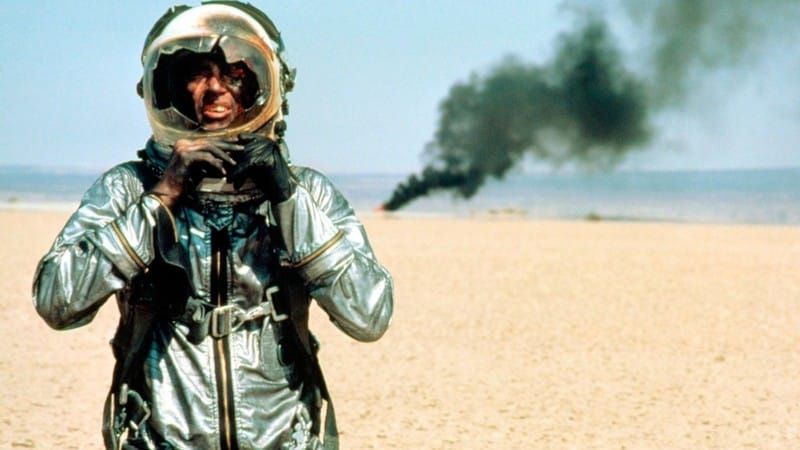
The Right Stuff (1983) dir. Philip Kaufman
“There was a demon that lived in the air. They said whoever challenged him would die.”
On the 14th of October 1947, Chuck Yeager became the first person in history to travel faster than the speed of sound and break the sound barrier. This flight, undertaken in the specially designed Bell X-1 (a bright orange jet that was little more than a missile with a rudder) launched manned flight into a new age. Hotshot Air Force and Navy pilots from around the United States flocked to the high desert of California just to push the outside of the envelope. The spectre of Yeager loomed large over the newcomers. They adopted his poker hollow West Virginian drawl, and his laid back demeanour – the echoes of which you can hear from commercial pilots the world over today. The men drawn to Edwards Air Force Base like immortality-seeking moths to the brightest beacon on Earth were called test pilots. They had a 1 in 4 chance of getting killed while testing experimental supersonic aircraft, and no one knew their names.
The spectre of Yeager looms large over Philip Kaufman’s 1983 historical epic, The Right Stuff. A miracle of filmmaking and storytelling that is simultaneously a fascinating (and relatively historically accurate) retelling of the early years of the US space program, a deep character study that contemplates what makes people like Yeager and the Mercury 7 astronauts tick, and a deft, subtle critique of America during what should have been a moment of genuine exceptionalism. This is a love letter to humanity, our ambition, and the people who take those ambitions, lay their lives on the line and fly into the unknown. It reminds the audience to look up, to strive, and to dream beyond the possible.
Adapted from pioneer journalist/author Tom Wolfe’s exceptional book of the same name, The Right Stuff is set at the dawn of the epoch-defining Space Race and details the early years of the United States’ space program. Beginning with Yeager’s triumphant breaking of the sound barrier in 1947, the film shifts focus to NASA, the Mercury program, and the first seven astronauts: Alan Shepard (Scott Glenn), John Glenn (Ed Harris), Gus Grissom (Fred Ward), Gordon Cooper (Dennis Quaid), Scott Carpenter (Charles Frank), Wally Schirra (Lance Henriksen), and Deke Slayton (Scott Paulin). Each of these men are unknowingly pushed to the brink of history, and face either immortality or death atop a rocket in a fiery televised explosion.
Kaufman’s screenplay is a masterpiece, filled with wonder, adventure, excitement, frustration, drama, tension, and terror. For a lesser creative, these tonal shifts would collide as serviceable individual components that are ultimately incompatible as a whole, but Kaufman weaves them together expertly and no moment feels out of place. The film doesn’t shy away from the ugliness of the space program. Kaufman revels behind the scenes, presenting the astronauts and the people who sent them to space as deeply flawed individuals, as we all are, all with problems of their own that are continually overridden by the looming night sky and the stars they aim for. Gordon Cooper’s marriage is falling apart but he needs his wife in order to be accepted into the space program, John Glenn’s Presbyterian boy scout manner brings him into conflict with the other, more cowboyish astronauts, and Gus Grissom is accused of costing the government and the program untold millions of dollars and shattering the reputation of the steely-eyed bearers of The Right Stuff.
The cast of The Right Stuff is absolutely phenomenal, and is one of the greatest ensembles ever assembled – certainly the best of the 1980’s. Casting director Lynn Stalmaster loaded the film with character actor heavyweights and incoming stars, all of whom play their role perfectly. Standouts from the main cast include Dennis Quaid at his most charismatic, Ed Harris as a quiet yet determined John Glenn, and Fred Ward as the sidelined Gus Grissom. Standouts from the endless list of supporting players include Jeff Goldblum, Scott Wilson, Donald Moffat, Barbara Hershey, and Kim Stanley. But it is legendary playwright Sam Shepard as Chuck Yeager who rises above all others in The Right Stuff and delivers among the greatest performances to grace the silver screen. It is a refined, restrained performance. He has few scenes and even fewer lines, but that only serves to give his scenes and lines a gravity that few others ever possess.
Yeager’s journey through the film is contrasted by that of the astronauts. While John Glenn and the others get on the cover of Life magazine, become household names, and fly faster – and higher – than anyone before, Yeager and the other pilots who remain testing in the high desert of California have their feet firmly planted on Earth. They continue to fly in anonymity, with a 1 in 4 chance of death each time they go up, and they return to the ground with no ticker-tape parade or meeting with President Kennedy. Yeager doesn’t seem to care. He certainly isn’t one for the endless press, the photographs, or the glamour of Houston – he seems much more at home riding horses through the desert with his wife – but I can’t help but feel he yearned to breach the next barrier. There’s a melancholic sense of the past conflicting with the future radiating from him.
In the waning half hour of the film Kaufman distils the thesis of the 3 hour and 13 minute runtime into one stand-out scene. Gordon Cooper, the last of the original seven to take flight, is asked by the press, “Who is the best pilot you ever saw?” This question sets up Kaufman to deliver a deft critique of the American obsession with exceptionalism and press-created mythologies. Gordo’s answer, complex and contemplative, is drowned out by chattering pressmen who do not care for such complexities and are searching for only a headline. There are countless amazing scenes in The Right Stuff, all with so much value and purpose – the phone call between John and Annie Glenn where John defies the orders of Vice President LBJ, or Yeager’s flight in the F-104 that serves as an epilogue to mirror his sound barrier-breaking prologue. It feels like a disservice to the film to single out just one.
It would also be a disservice to write about this movie and not mention the flawless technical work behind the camera. Caleb Deschanel’s cinematography is like nothing else from that era, it feels timeless. His shooting of the space scenes, especially Glenn’s flight with the “fireflies”, and the bizarre warping images of the sound barrier are absolutely awe-inspiring. The visual effects, editing (some cuts will take your breath away) and sound also need recognition: they are all industry best and the film wouldn’t work without them. At the top of the list of things The Right Stuff couldn’t work without is Bill Conti’s score. It’s a perfect composition that incorporates elements of Gustav Holst and 80s synth. Unique, nail-biting, and rousing, Conti makes you feel like you can fly.
None of the Mercury 7 expected or foresaw a day in the not-too-distant future when their names, once imbued with the righteous aura, and synonymous with ‘defender of the heavens’, would once again sink into obscurity. The Right Stuff brings them back. It shatters the myth of these early Cold Warriors and builds wholly new ones that account for their failings, their flaws, and their humanity. The Right Stuff is guaranteed to make you smile; yearn; hope – it might even make you cry – and for a brief moment, you may want to be the greatest pilot anyone has ever seen.