The Smithys: Film Review Fridays Awards Show Special Feature
Together, we've come up with five awards categories that will change the way you look at cinema in 2025
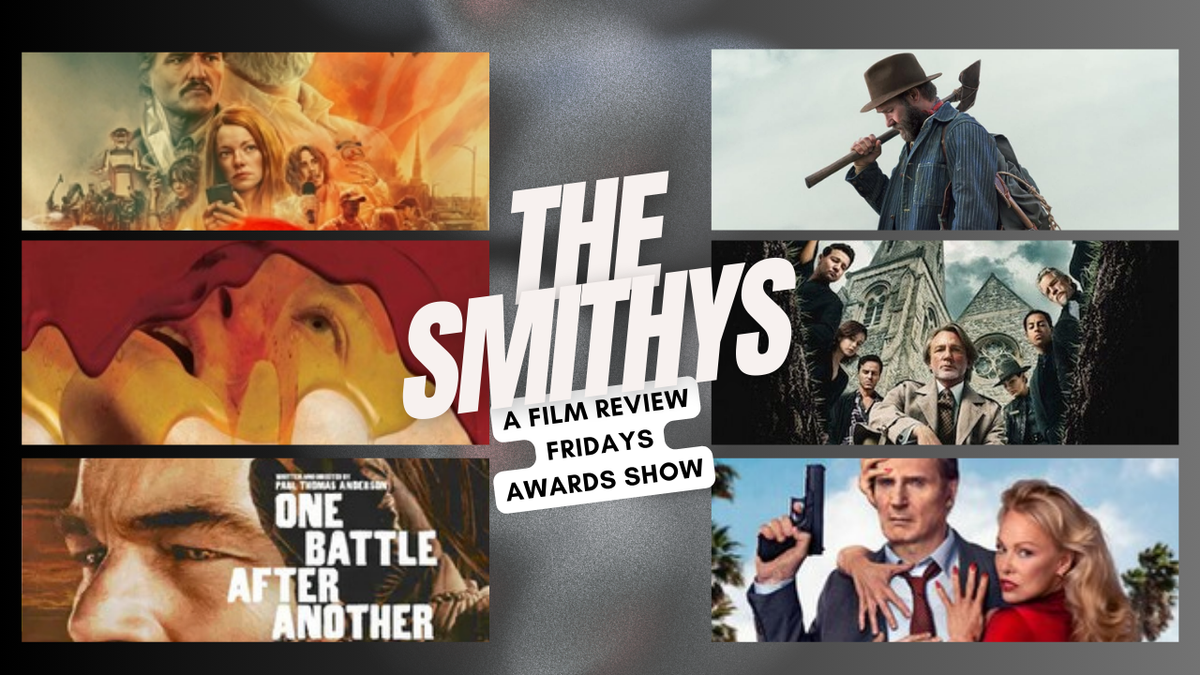
As far as film goes, 2025 has been a good year. Even with more new releases this year than we'd know how to keep track of, we've seen dozens of movies between the three of us – not to mention spent hundreds of hours at cinemas or in front of movie screens, and (of course) written innumerable reviews.
What better way, then, to celebrate this fabulous year than with our very own awards show? It's no Oscars, but we've got something much better to offer you: THE SMITHYS.
Do you ever get tired of the same old categories? Best actress this, best screenplay that – but what about the little things? Where are the awards for the overlooked components that make films what they are; the unregarded elements that cinema couldn't go on without? Where are the awards for best tagline, or best title? Why aren't people awarding the best poster? We don't have an answer to this, but we do have the solution.
Together, we've come up with five categories that will change the way you look at cinema in 2025: Best Line of Dialogue, Best Protagonist, Best Poster, Best Tagline and Best Title. By voting for each of these and choosing our most popular winner, we've compiled a list of some of the films that have most excelled this year, and why.
Welcome to THE SMITHYS.
- Best Line of Dialogue: The Naked Gun, dir. Akiva Schaffer
“The case was starting to give me an itch. And when I start to scratch, I don't stop till I break skin and the doctor makes me wear mittens”
Akiva Schaffer’s The Naked Gun will likely be regarded as one of the most faithful film reboots ever developed. Like the original Zucker, Abraham and Zucker classic, almost every line featured a rib-tickling joke, which made it the undeniable winner for ‘Best Line Of Dialogue’. The question was, which line? Most jokes needed a response by a straight man. After another rewatch, we were able to settle it down to two winning lines, a vulgar comment about Pamela Anderson's rear and this year's winning line. I believe this line perfectly represents the franchise and demonstrates how parody should be executed: adoption of style, subtle buildup and ending with a ridiculous and clever punchline. Of course, bastardized methods of parody still work marvellously (Austin Powers, Scary Movie), but this line proves that when it comes to scriptwriting, whether parodical or not, The Naked Gun is in a class all of its own.
- Best Protagonist: Bob Ferguson, One Battle After Another, dir. Paul Thomas Anderson
Bob Ferguson is a character close to giving up. He isn’t using his real name, his daughter (whose safety occupies every sober thought he has) is growing older and more difficult to protect, and the cause that he dedicated so much to is faded. Bob sits around in a robe channelling Jeffrey “The Dude” Lebowski, and describes himself as “a drugs and alcohol lover”. He doesn’t appear to be the ideal protagonist – and he isn’t – but that’s what makes him perfect. Bob is manic, and scurries through and out of trouble. This revolutionary turned father may not have kept up with the passage of time, but his endless struggle against the forces that restrain him (externally and internally) shows that keeping the fight going is the next best thing to winning it.
- Best Poster: Bugonia, dir. Yorgos Lanthimos
The most popular poster for Bugonia depicts viscous red and yellow liquids (blood and honey) oozing down from the top half of the image to cover the face of the film’s lead, Emma Stone, whose expression is a mix of rapture and fright. Described as representing the idea of “humanity and nature attacking” Stone (a theme closely tied to the film), the poster immediately sets audiences up for a multi-layered and mesmerising motion picture. Credits, in stark black lowercase, occupy only a single corner at the bottom of the poster, with the title in an almost alien-seeming font that at first glance might be illegible. The poster image, like the actual cinematography, appears somehow grainy despite the rich magnificence of its colours. As a whole, the poster is fascinating and unusual, and looking at it, one can’t help but slip into an expression very much like Stone’s, and very fitting for the film – awed, captivated and struck by something extraordinary.
- Best Title: Train Dreams, dir. Clint Bentley
Before a movie is filmed, before a poster is made, and maybe even before the screenplay is written, all that exists is the title. It’s the first contact most people have with a film, and as such it is one of the work’s most valuable assets. A weak title won’t destroy a great movie, but a great title can reach into the mind of an audience and spark their imagination before the film has even released. Train Dreams ignites that spark unlike any other title from this year. It is mysterious, poetic, and evokes a sense of melancholic wonder that perfectly encapsulates the tone of the film. By the time credits roll on Train Dreams you realise no other title could possibly fit, as it all, at last, connects.
- Best Tagline: ‘Hindsight is 2020’, Eddington, dir. Ari Aster
I'm sure we can all cast our minds back to the catastrophic year that was 2020. The year we stayed indoors with minimal contact to the world. The year that brought meteoric rise to the Black Lives Matter movement when George Floyd was unfairly suffocated to death. The year that was supposed to kick off this decade on a high note, but instead leveled our expectations to a new low. But after five years, we cannot let one single year define our generational ideology. We cannot let toxicity consume us. We cannot let us forget that we are still young, we have our whole lives ahead of us and there's not enough time to spend a second of it on hate. Don't misunderstand, there's every reason to protest injustice, but we can't let it change us or the world forever. The tagline for Eddington argues that we never left 2020, that we never had the hindsight to spot the elements from that evil year, repeating every year since. Or perhaps we simply accepted 2020’s nature as that of the world today. The tagline sets a horrific, haunting tone that still wouldn't prepare you for Eddington’s reflection of the COVID era.
And with that, we move onto our final category: Best Picture. I know I said we were staying away from most traditional categories here, but this one has an exception. Some films simply need more said on them, or need to be highlighted even if they didn’t win in one of the other categories, and besides – does it really feel like a complete awards show without ‘best picture’? This is the film; each of us has selected our favourite from the films we’ve seen this year and argued for why it should win best picture.
Mason: Eddington, dir. Ari Aster
I believe Eddington is the greatest film of our generation because of its horrifying reflection of the modern world. Ari Aster has demonstrated through ‘Eddington' that the issues that began from the year 2020 haven't resolved, they're still here, we're still suffering. The best way he's done that is through having no protagonists at all, every character in their own way is flawed. Joe Cross doesn't follow COVID rules, Ted Garcia is corrupt, Vernon Jefferson leads a speculative cultish movement and Louise Cross follows along, with her mother feeding the family conspiracy theories. The reason I chose this as as my pick for Best Picture is that it opened my eyes to how hostile the world has become. Everyone is angry, everyone has problems and that's okay, but we have to understand the right way to handle it. Eddington showed me that we've been in a horrible place the last five years, but it's also shown me how confusing it is to pull ourselves out of that place. Are we doing the right thing? Are we doing it wrong? Are we just drifting in the wind? I have no idea, but we need to have the conversation. We need to stop fighting for a bit and talk.
Emma: Wake Up Dead Man, dir. Rian Johnson
The magnetic third installment in the Knives Out franchise, Rian Johnson’s Wake Up Dead Man is another epic mystery following the inimitable detective Benoit Blanc, who this time takes a small rural chapel as his field as he investigates the suspicious death of a local religious leader. Although not as comedic as its predecessors (2022’s Glass Onion and 2019’s Knives Out), Wake Up Dead Man has a good claim to being the series’ finest installment yet. Daniel Craig – whose Blanc might be among the most memorable mystery characters this century – leads an ensemble cast including Glenn Close, Jeremy Renner and Josh O’Connor, whose acting as boxer-turned-priest Jud Duplenticy is the single most powerful and jaw-dropping turn I’ve seen all year. The film is never predictable or expected, and remains gripping for the entirety of its 2+ hour runtime. It offers almost breathtakingly sharp insight into the nature and appeal of faith, without ever appearing to favour any one side, and viewers are guaranteed to be blown away by the sheer mastery that this picture displays in every single facet.
Daniel: Train Dreams, dir. Clint Bentley
Clint Bentley’s gut-wrenching exploration of grief, life and the ceaseless progression of time is likely to knock the wind out of you. This visual poem demands the full attention of the audience in its most quiet and gentle moments and forces the grief of a life lived as countless lives are lived, have been lived and will be lived to flow off the screen. Train Dreams is a film about connection. Through our lives we build tracks that we traverse daily for years on end that, without our knowing it will be paved or grown over and forgotten. The vast tapestry of time is woven with such tracks, and is mottled with holes left by threads yanked out of place. The world keeps turning, and Robert Grainier (Joel Edgerton with career-best work) is dwarfed by the enormity of it all. He works for a logging company in the North-Western United States, culling forests of redwoods that were saplings during the time of the Roman Empire, a gargantuan fire with flames as tall as skyscrapers rips through his home, and builds bridges over canyons and gorges. Grainier changes his little corner of the world as much as possible, but time covers the scars he leaves. The world, and time itself, are unsympathetic to our all too brief plight. Train Dreams posits that people must have sympathy and empathy for one another, must love deeply, mourn thoroughly, and when it all reaches its inevitable climax, must consider the beauty of every moment, of everything from birdsong to tears, take a breath, and breathe with fresh lungs and a full heart.