UOW put on blast before the NSW Parliament
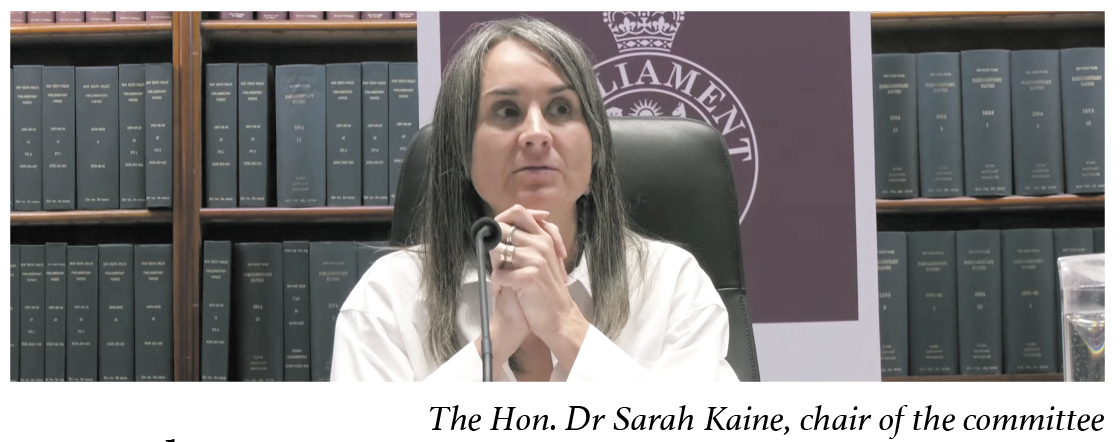
The New South Wales Parliament’s Standing Committee on Social Issues has released an interim report on the 8th of April following investigations and hearings across several months from their inquiry into the university sector, which is still ongoing.
The interim report was aimed at addressing issues surrounding the University of Technology Sydney (UTS), the University of Wollongong (UOW), and various consultancy firms involved in the decision-making of these universities.
A key finding of this report is an under-utilised power in the University of Wollongong Act 1989 (NSW), Section 21D, which allows a state minister to request a report from the university on their commercial activities. UOW operates under what Finding 2 considers “complex subsidiary structures” and the Hon. Steve Whan, Minister for Skills, TAFE, and Tertiary Education, has been recommended by the council to request that UOW provide a report on their commercial activities and related entities, most notably UOW Global Enterprises (UOWGE).
The report also found, in Findings 3 and 4, that existing legislative structures do not provide the public with a transparent look into the financial and commercial activities of NSW universities. Revisions to the Government Sector Finance Act 2018 (NSW) have been recommended “to remove the exemption applying to a council of a university, thereby requiring all NSW universities to disclose all consultant expenditure – whether expensed or capitalised.” Reforms to the Government Information (Public Access) Act 2009 (NSW) have been recommended so that universities will be held to a higher standard of transparency and will be made to disclose their commercial expenditure to consultants. The NSW government will also aim to “strengthen oversight of contract register compliance to ensure that claims of commercial‑in‑confidence are applied consistently and satisfy the public interest test,” committing to the principle that future GIPA requests made by the public will be evaluated in accordance with the government’s proposed reforms.
All roads seem to lead back to the University of Wollongong Act 1989 (NSW), and a key aspect and goal of the act being for UOW to provide “provision of facilities for education and research of university standard, having particular regard to the needs of the Illawarra region.” The operations of UOWGE seem to stand in direct conflict with this public mission, as a private corporation that operates campuses overseas. Expansion of campuses overseas, especially with a proposed new international campus being set up in Riyadh, Saudi Arabia, seems to come at the expense of UOW’s domestic campuses and the various cuts we’ve experienced to supposedly save costs. Former UOW National Tertiary Education Union (NTEU) Branch President Dr Fiona Probyn-Rapsey had called out UOWGE on this issue, saying “How does UOWGE justify spending money on a campus in Saudi Arabia and not use that money to support the public mission of the university, as stated in the UOW Act, to provide research and education with ‘having particular regard to the needs of the Illawarra region’?” While staff lose their jobs here in Wollongong, Group CEO of UOWGE Marisa Mastroianni has put her salary around the range of $600,000, and she is on record before the committee stating that the international campuses in India and Hong Kong are not turning a profit.
Last year’s hearings
On the 17th of December 2025, the committee heard submissions from staff and students of UOW. Several academics, including Dr Adam Lucas, submitted a critical response to the inquiry on the basis of the corporatisation of the university with 20 recommendations. Some of these included the establishment of a state government university governance review panel and the establishment of guarantees of academic freedom and transparent financial reporting. In discussing his submission to the inquiry, Dr Lucas mentioned that often universities, including UOW, depreciate assets acquired for free through government grants to “make their finances look worse than they actually are.” Thus, through portraying themselves as being in financial strife, universities can justify job cuts and cuts to entire disciplines.
Both the former and current UOW NTEU Branch Presidents, Dr Probyn-Rapsey and Dr Susan Engel, were also heard in the inquiry. They echoed similar concerns about the lack of accountability for university councils, as well as the decrease in course offerings for UOW’s onshore campuses at the same time as opening a new Dubai campus. Dr Engel offered a human account of the suffering the university’s restructure had caused, recounting that a student had told her that “the last year had been the worst of their life as they tried to navigate all the changes to their degree.” Professor Probyn-Rapsey addressed a question from the Chair about conflicting reports in regards to John Dewar working at both KordaMentha and UOW. Professor Probyn-Rapsey confirmed that her understanding, as per the union’s GIPA submission, was that “he was working a nine-day fortnight with one day set aside for mentoring with KordaMentha staff.”
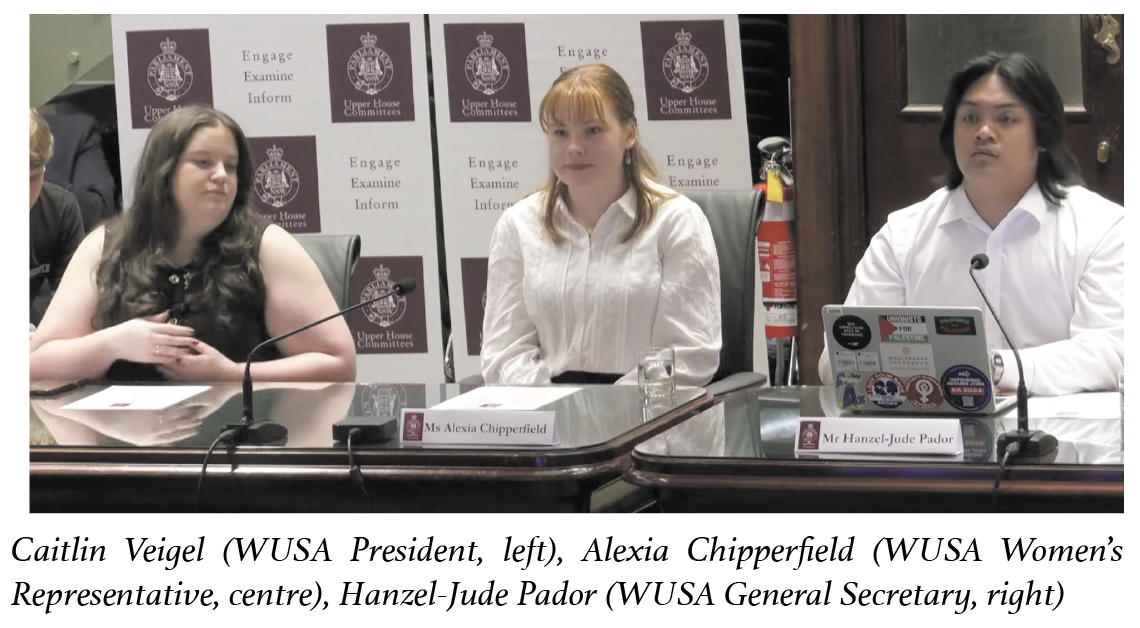
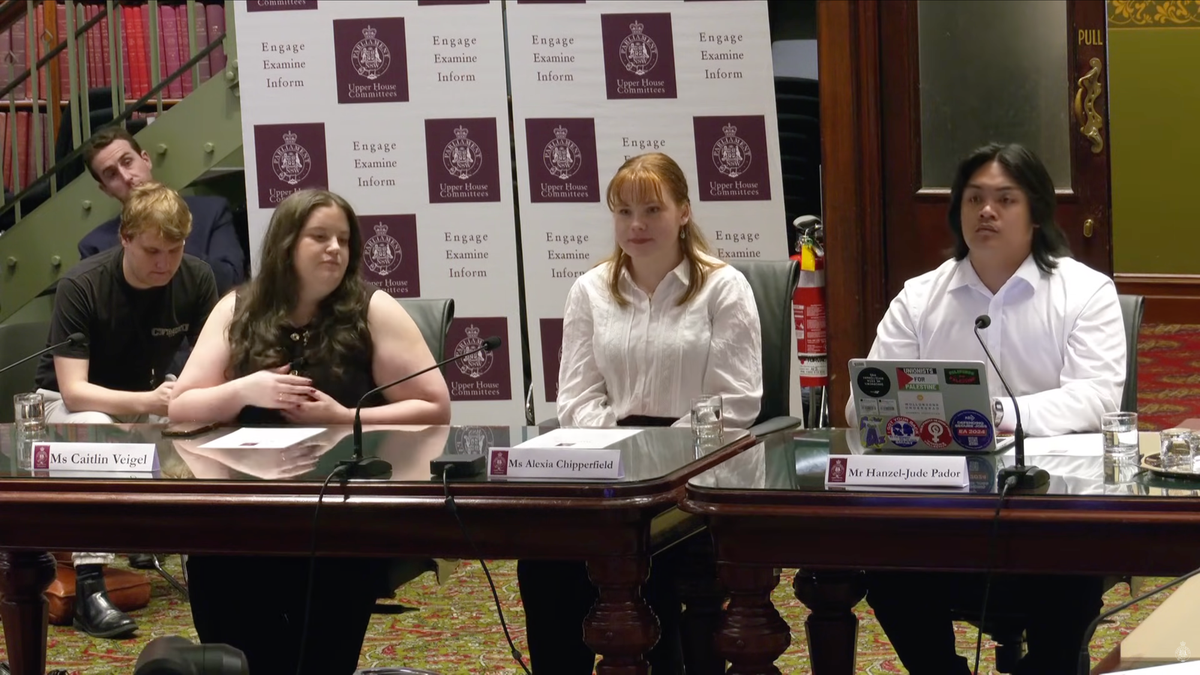
Next, the inquiry heard from several members of the WUSA: outgoing WUSA President Hanzel-Jude Pador, incoming WUSA President Caitlin Veigel, and WUSA Women’s Representative Alexia Chipperfield. They voiced concerns about the lack of transparency and accountability in university governance, as well as the lack of meaningful student voice structures. In particular, there were concerns raised about how the Student Advisory Council (SAC) was elected, and the lack of transparency about said elections. Other concerns raised included the proposed changes to Safe and Respectful Communities (SARC) and WUSA’s Save SARC campaign, delays in the distribution of the Student Services and Amenities Fee (SSAF) and the management of the SSAF belonging to the SAC rather than the democratically-elected WUSA. In response to WUSA’s submission, the Hon. Abigail Boyd fittingly commented, “I'm trying to think of a better way to say this without swearing — It's in the dictionary now, this enshittification of universities that we have now in Australia — it costs more, you've got no ownership over your own educational institution anymore, services are cut, everything's just worse.”
The rest of the meeting heard from other members of UOW staff, particularly its executive staff. What followed were a slew of bizarre moments, including potential memory loss such as when Group CEO of UOWGE Ms Mastroianni being unable to remember her salary when asked by the Hon. Anthony D’Adams. Unable to provide this figure, Ms Mastroianni continually requested to take the Hon. Mr D’Adam’s question on notice even as he repeatedly reminded her that you cannot take a question on notice if you have the answer available. When she was asked for a ballpark figure, she eventually let on that her salary was about $600,000 a year.
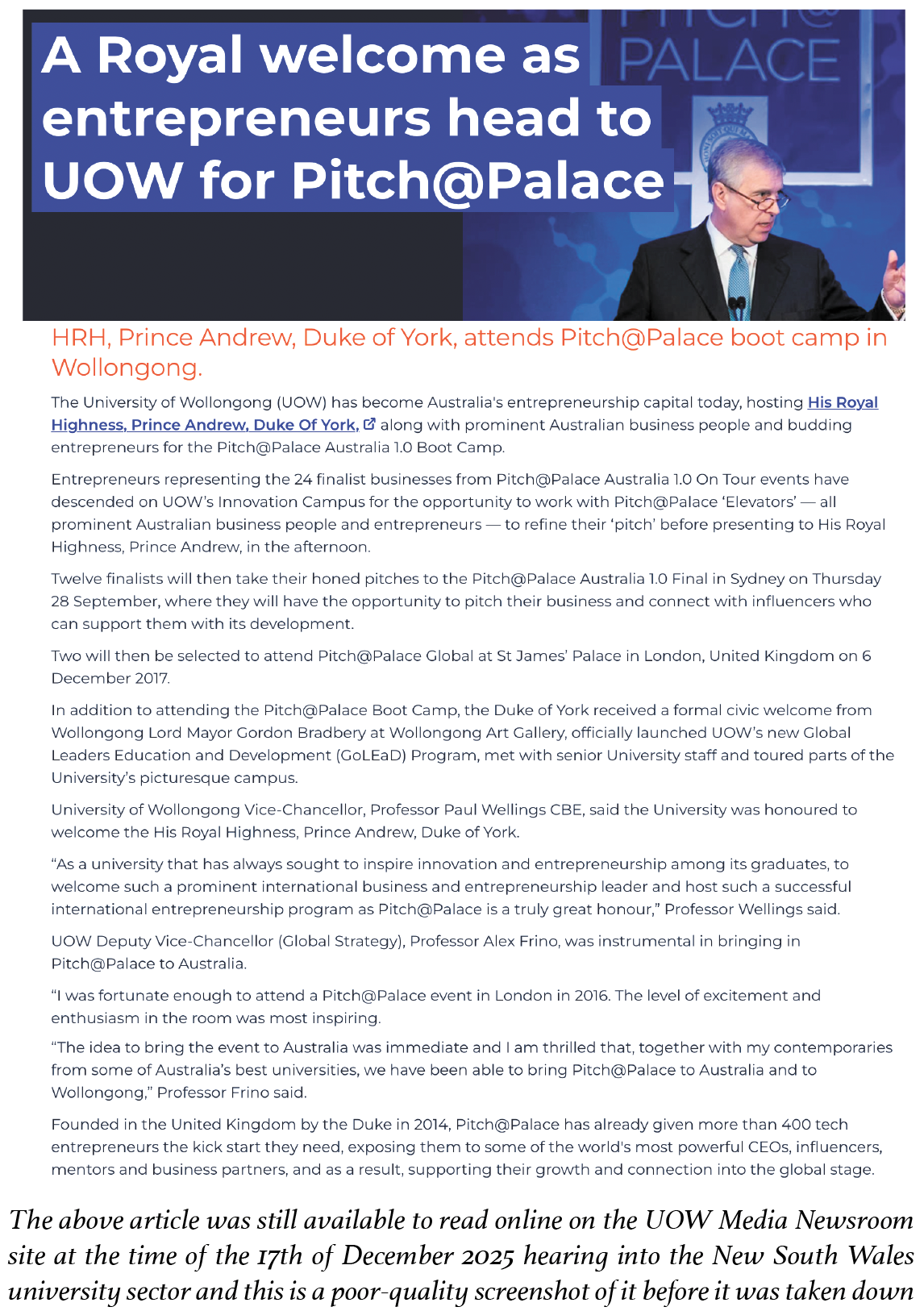
Another particularly odd moment came in relation to, of all people, Andrew Mountbatten, formerly known as Prince Andrew. UOW was formerly involved with Andrew’s ‘Pitch@Palace’ program and in 2017, university funds were used to renovate the executive bathrooms in preparation for his arrival at the university. Again, amnesia occurred for Deputy Chancellor Warrick Shanks, who was unable to recount the cost of these renovations. Shanks was also questioned about UOW’s relationship to the Tottenham Hotspur Football Club, which involved the funding of numerous overseas trips for the university executive. Mr Shanks also had to take questioning in regards to this on notice, as he could not recall the specific strategy at the university at the time.
Since the interim report
Since the interim report, hearings have continued with a recent session on the 1st of April including former interim Vice-Chancellor of UOW, John Dewar, in attendance.
Decisions made about NSW universities do not lie within the hands of their students, nor their academics, or even the majority of their professional staff. Rather, the modern Australian university is increasingly reliant on outsourcing to consultants for major decision making. Consultancy firms were used extensively throughout the 2024-2025 “Final Change Plan” period. Consultancy firms are used to conduct operational reviews which advise which cuts to staff, degrees, and course content could be made, disrupting study for students and causing significant workplace psychosocial hazards for staff, which UTS was also a victim of as per the findings of the report, during their own period of cuts. Beyond this, decision-making is not only being outsourced to consultancies, but also consultancies are entering executive positions at universities. Mr Dewar was a partner at the consultancy firm KordaMentha prior to his position at UOW, and took “unpaid leave” during his time as VC. KordaMentha was the same consultancy firm that conducted an operational review that led to significant job cuts.
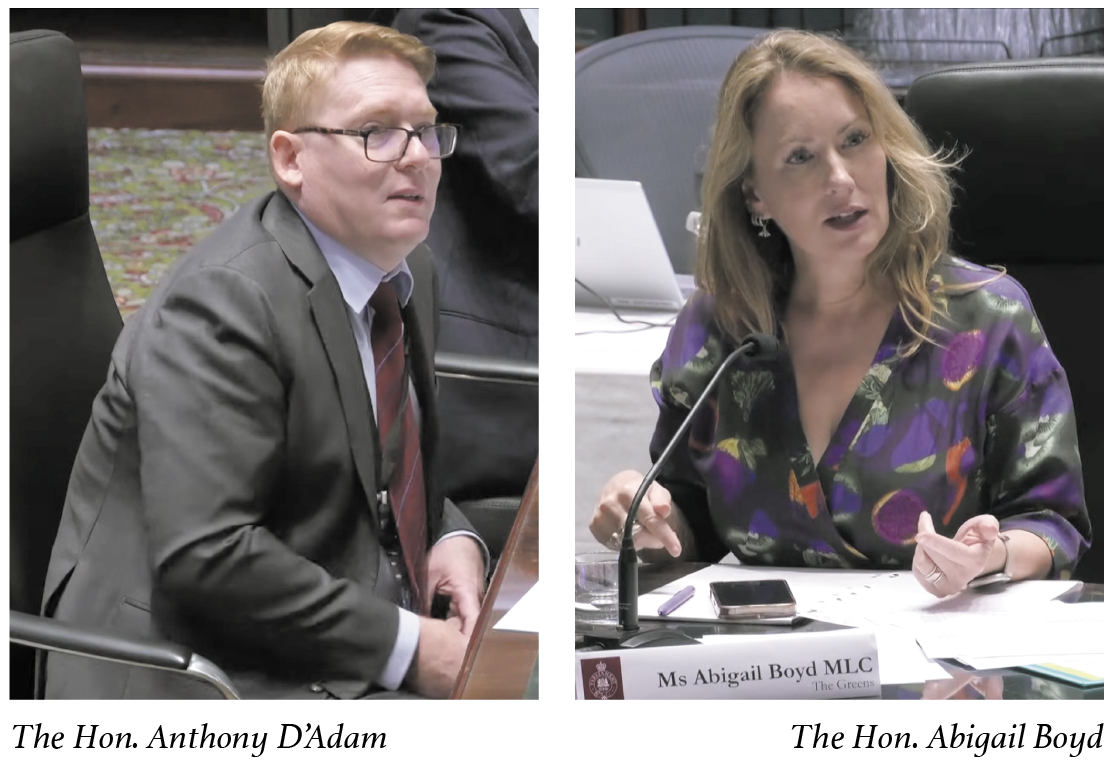
Mr Dewar consistently denied that he had a financial interest in his partnership with KordaMentha while acting as interim VC. The committee seemed perplexed by his statements however, as he stated, in his own words, that while he was on “unpaid leave”, he was “entitled to a fixed remuneration, part of which was made up of a fixed amount of profit.” Profit that was directly tied to KordaMentha’s work at UOW. The Hon. Ms Boyd was unconvinced, stating “what you did in your job at the University of Wollongong and what you did in relation to KordaMentha was going to come back to your profitability as a firm and then your direct financial interest, it's a direct conflict of interest.”