
UTS staff strike back
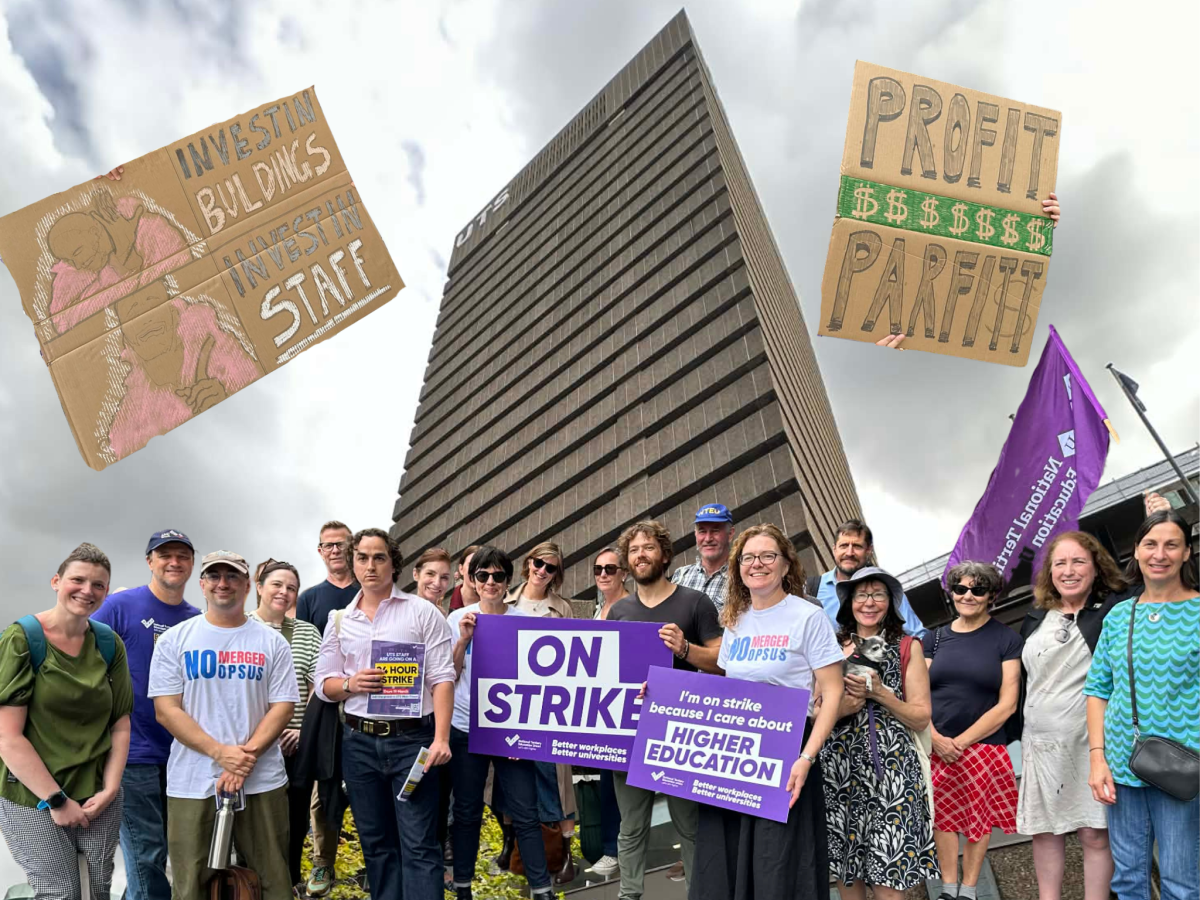
Members of the National Tertiary Education Union (NTEU) coordinated a 24 hour work stoppage from 8am on the 19th of March on behalf of staff at the University of Technology Sydney (UTS).
The NTEU made a number of demands from university management, including requests for a fair pay rise, reproductive health leave, safer workloads, and reassurances of job security following the forced redundancies of 121 staff members, some of whom gathered in the strike despite facing the loss of their jobs next week.
After seven months of negotiations, UTS’ Chief Operating Officer Glen Babington has responded to only one of the demands of the NTEU with a 1.5 per cent administrative pay increase. This response came during the strike when a UTS staff member shared the email from Glen with their fellow strikers, who booed upon hearing the percentage.
Leading the strike from 8am to 2pm, the President of UTS’ NTEU Branch, Dr Sarah Attfield, shared the union’s difficulty in negotiating with management and how dismissive they have been of concerns made by staff at the university.
“They suggested that we don’t represent staff, that we’re talking of our own personal opinion,” Dr Attfield said.
“At times [UTS management] look like they’re really bored and fed up with the whole process [of negotiating].”
At the end of last year, the NTEU released the results of a survey which was open to all staff at UTS, asking them to share if they had any confidence in Vice-Chancellor and President Andrew Parfitt’s management of the university. 95% of respondents voted no.
A member of UTS’ Parental Leave Working Group, Grace Dulawan, shared her experience going to a bargaining meeting with management with the goal of improving reproductive health leave conditions that would meet the needs of staff.
“I was met with absolute disdain, I have never felt so hated in my life,” Dulawan said.
“UTS and Andrew Parfitt love to talk a big game about social justice, about equity.
“At the International Women’s Day event the other week, one of the speakers called Andrew Parfitt out and talked about the fact that UTS has, in some of their parental leave conditions – specifically around miscarriage, one of the worst conditions in the sector.”
The working group informed management of how to improve reproductive health leave by covering endometriosis, chronic illnesses to do with reproductive health, screenings, and miscarriages.
“When I was at the bargaining meeting, I said: ‘You guys last year endorsed a gender equity action plan endorsed by the [UTS] council, number 5 on that priority list is support for parents and carers. What are you doing in this space? We’re offering you a way to actually come good on your word’,” said Dulawan.
“They said: ‘Well we can’t really afford to, we’re not in the position, we’re not in a position to take action on that’. Well then don’t put it everywhere, don’t talk a big talk, don’t pretend like you actually care about social justice.”
Neeve Nagle, the President of UTS Students’ Association, was present to show solidarity with the staff on strike.
“We represent every single student: undergraduate or postgraduate, inside these buildings,” she said.
“I am here to say that we stand with you, we stand with staff on strike, and that student learning conditions are staff working conditions. And we understand that.”
Many UTS students who were not showing solidarity with the strikers were gawking and recording the demonstration below them from the windows and balconies of the UTS Tower.
A few groups stood in solidarity with the staff on strike, mainly other NTEU branches, as well as student activist group Stop The Cuts UTS, the NSW Socialists party, and the National Union of Students Education Officer, Yasmine Johnson.
Yasmine was present at the strike in her capacity as NUS Education Officer, but also as a student of UTS.
“The course that I’m doing, Languages, is on the chopping block, and they won’t tell us how long the courses are going to continue for or if we will be able to finish our degrees or not,” she said.
“Tutors I’ve had don’t know whether their job is gonna last six months more, three years more, and as staff leave it leaves the remaining staff overworked.
“All over the country we’re seeing a bit of a fight that [staff] want to put up and there was actually a strike at [the University of] Newcastle not too long ago and I think that’s what students all over the country want to be supporting.”
Also present was President of the University of Sydney’s (USyd) NTEU branch, Peter Chen, who passed on messages of solidarity from the neighbouring university’s union members.
“Your friends at the University of Sydney have watched [you] with pride,” he said, reflecting on how past strikes at UTS pushed USyd’s management to walk back on plans to fire 5 per cent of professional staff.
“Your fight helped us win our fight, it inspired our activists and it scared our management, so thank you, Sydney owes you a huge debt for your struggles.”
A one-hour work stoppage is planned for the 1st of April for the UTS NTEU branch. It will act as a meeting for members to plan their next direct actions for the rest of the year.
Additional reporting by Dylan Chesher, Jared Kimpton, Teagan Nguyen, and Tyberius Seeto. Originally published in Honi Soit.