Her Re-Review – Film Review Fridays
A look back at Spike Jonze's 'Her' in light of the increasing proliferation of AI.
I’ve long wanted to re-review Her, but was never quite sure of the best time to approach it. I wrote the original review for the Tert's ‘Heartbreak’ issue last year around Valentine’s Day, so one would assume this year’s celebration would have been the ideal time, but it didn’t feel that way to me. Maybe it’s my own personal view (which, it must be said, is akin to that of a hermit, admittedly – I don’t go out much), but I've felt that romance is on its final breaths. There are too many different causes to count, to sort through and examine. Maybe the romantic climate today is due to our year indoors during COVID; maybe it’s the loneliness epidemic; maybe it’s socio-political views that got spread far too frequently with far too much emotion. And yes, maybe this is all in my own head. Whatever the case, I would say I’ve had trouble finding the right time because romance feels all too much like a myth.
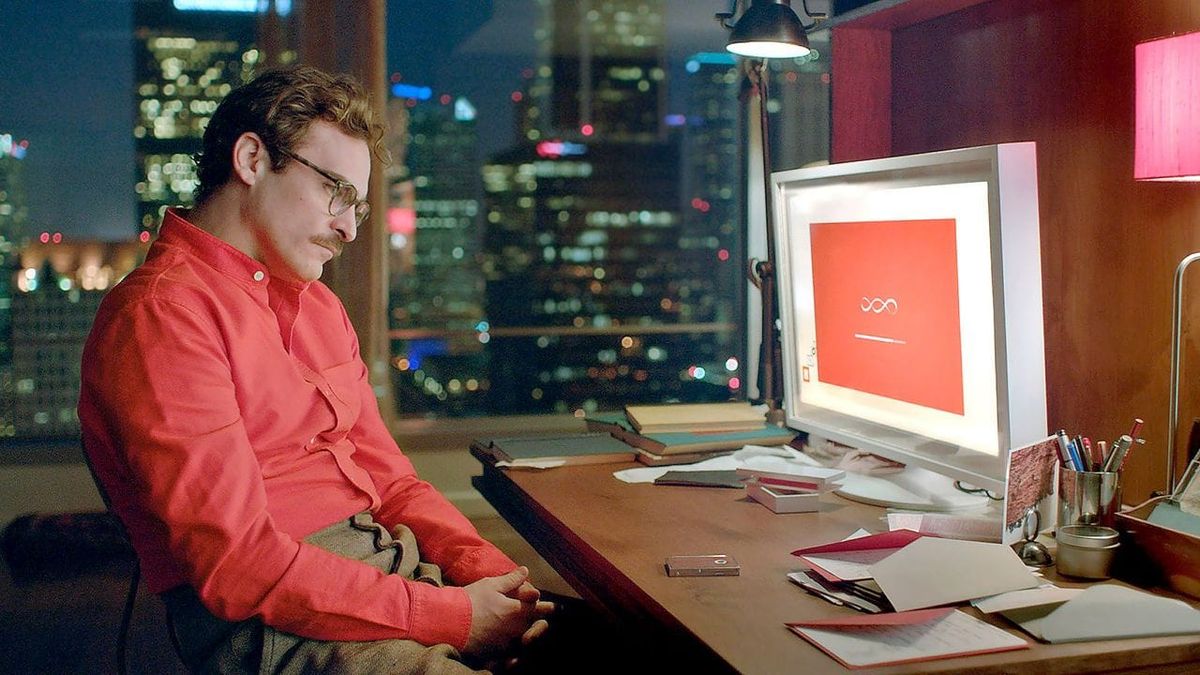
Why am I writing this review now, then? Because I have the haunting feeling that the climate is going to get much worse. If you haven’t seen Her, the film follows Theodore Twombly as he falls in love with an AI program called Samantha. At the time (2013), AI was still in incredibly early stages, and though you’d be right to laugh at the film’s premise, director Spike Jonze presented it as an idyllic fantasy. The cinematography paired with the soundtrack gave the film a meditative and reflective feel, which can be attributed to his past filmmaking partnership with Charlie Kaufman (Kaufman having written 2 of his other narrative films).
This year, Her seems to be becoming a reality, with people beginning “friendships” with ChatGPT (I’ll admit I’ve partaken in conversation with it, as well as a couple rounds of ‘Six Degrees’) and soon, I predict, more adult relationships. On October 15th of this year, Sam Altman, the CEO of OpenAI posted on X that “In December, as we roll out age-gating more fully and as part of our “treat adult users like adults” principle, we will allow even more, like erotica for verified adults”. Her is no longer science-fiction.
This development demands Her be re-examined. The relationship between Theodore and Samantha was such a beautiful one because it felt that they understood each other like no one else ever could. But now that a Scarlett Johansson-voiced AI girlfriend could soon be, not only possible, but more accessible than ever, we need to strip away the fantasy and face the stone cold reality. Is Her romantic because it’s about a man finding love when he never thought it was possible, or is it just romantic because Scarlett Johansson’s voice masks the fact that Theodore is in love with lines of code? Are Her and the “treat adult users like adults” principle stepping stones for a new movement of romance?
It’s absurd to consider at first, but when you consider our generation’s loneliness epidemic, the hell that is online dating, and the fact that some people are just completely done with dating, it makes sense. The major goal of dating is to find someone that truly understands you, and if you spend enough time talking to ChatGPT, you’ll find that is all too easy to fake. Whenever you confess a frustration or problem to GPT, chances are, it will be begin with “It makes sense for you to feel that way” or “Oof, ouch. Yeah, that would feel ____”, but humans aren’t automatically like that. Humans question and contradict, they call you out when you need to (and of course, sometimes when you don’t need to), GPT is permanently on your side, ready to call every single one of your thoughts the best idea ever. When AI generated erotica is rolled out later this month, do you think people participating would ever go back? Even if the isolation from humans places them into a deep depression, do you think they would ever go back when they have all they want?
After rewatching Her last night, I came to a realization I should have had much earlier. I've had it all wrong this whole time. The film isn't romantic, it's a character study of a man who's given up on love. When we first meet Theodore, it's clear he's only looking for quick and easy sex and closes himself off from any potential romance for fear of repeating his failed marriage. In the first act, Theodore goes on a date with an unnamed woman, played by Olivia Wilde. It's clear there's potential, but during a make out session, when the woman asks if they'll see each other again, Theodore quietly rejects her. If I was in his position, I'd probably understand, but this action reinforces an idea about him proposed by his ex-wife, Catherine. “You always wanted to have a wife without the challenges of actually dealing with anything real and I'm glad that you found someone.” There's no reason for Theodore’s rejection of the woman, but by rejecting her, he's closed himself off even further, and reinforced the desire for easy sex and the villainisation of not only his ex-wife but any future spouses.
I think the moral of Her is the antithesis of ChatGPT’s upcoming update, that human connection, human romance is the key. People can hide away with porn all they like, but there comes a time when we have to stop denying ourselves the possibility of meeting the One. It's so easy to hide away when we know how much pain is involved in a journey like that, but it's a journey that makes life worth it. People will ignore the pain of porn, the lingering feeling of loneliness just because they perceive it as minor compared to rejection, when in actuality, it's another step down into depression. Her teaches us that though the easiest solution is the most tempting, the hardest solution can often be the most healthy, the most fulfilling and the most rewarding.